

Toilets get used. And, if we want to stay healthy, we’ve got to clean 'em regularly. Fortunately (or not), there’s no shortage of ways to do that: bottled gels, detergent pucks, sprays, foams, fizzes. Any of these cleaners will kill germs and can leave things vaguely smelling like industrial lemon or some other non-toilet-related scent.
But, for all their necessity, most toilet cleaners come with a lot that we—and the planet—don’t need. Most bottled options are up to 90% water, and come in single-use plastic containers. Fossil-fueled packaging aside, shipping all that liquid adds unnecessary weight, and, therefore, emissions. Consider, for example, that nearly 30% of a water bottle’s planet-warming potential comes from schlepping it around. One solution to both problems: embrace the tablet. Toilet-cleaning tablets are compact, dry, and typically come in recyclable or compostable packaging. They’re lighter to ship, easier to store, and don’t require a trip to the market every few weeks.
Using them is simple: drop one into the bowl, let it fizz, and get to work with a toilet brush. Most rely on citric acid, baking soda, and other biodegradable ingredients to clean and deodorize the toilet. No, they don’t disinfect, but they do remove stains and residue and generally keep things fresh.
But the real question is: Do these tablets get the job done? We spent a month plopping, fizzing, and scrubbing toilets in a busy household plagued by hard water and questionable aim, and the answer is “yes.” We evaluated cleaning performance, packaging waste, ingredient transparency, and overall usability. Some tablets fizzled out. Others won us over. Here’s what belongs near your bowl.
one5c’s pick: Blueland Toilet Bowl Cleaner Tablets
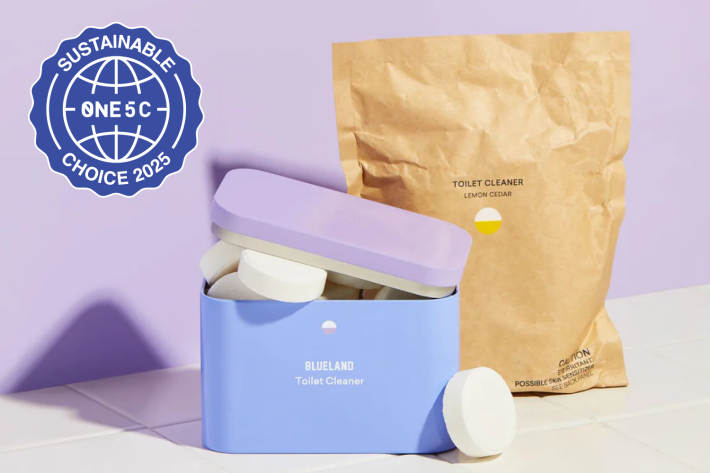
These substantial shuffleboard-puck–sized tablets cleaned up toilets—and the competition. They fizzed satisfyingly, dissolved quickly, and left toilets genuinely clean and fresh-smelling without any trace of nostril-stinging fake scents. Dried peanut butter, hard water stains, and all manner of skid marks came off easily with just a soft-bristled brush. They’re also the cleanest (heh) cleaners on the roster, with a fully transparent ingredients list and the most-minimal packaging of the lot. Blueland is also buttoned-up from a planetary perspective; their biggest brag might be that they’ve nixed almost all emissions from their operations and energy use. ($18 for 14 tablets; blueland.com)
Runner up: Clean People Toilet Cleaner Tablets
While these smaller, individually wrapped tablets didn’t produce as satisfying a sizzle as Blueland or leave our bowls smelling nearly as fresh, they cleaned up messes quickly with no hard scrubbing required. The company is transparent about its ingredients list, and the tablets don’t contain anything harmful or toxic, but there’s little information available about the firm’s eco-profile as a whole, which landed them in the middle of the pack in our sustainability sniff tests. ($24 for 24; cleanpeople.com)
What toilet cleaning tablets we tested
In addition to sourcing plop-and-fizz cleaners that are well reviewed, available at multiple retailers, and range in price from $0.83 to $1.29 per use (roughly equal to traditional gels and discs), we looked for those that have simple ingredients and are safe to use in septic systems. After researching the market, we landed on four competitors:
- Blueland Toilet Bowl Cleaner Tablets
- Clean People Toilet Cleaner Tablets
- Fab Tab Toilet Bowl Cleaner Tablets
- True Fresh Toilet Bowl Cleaner Tablets
How we picked the best toilet cleaner tablets
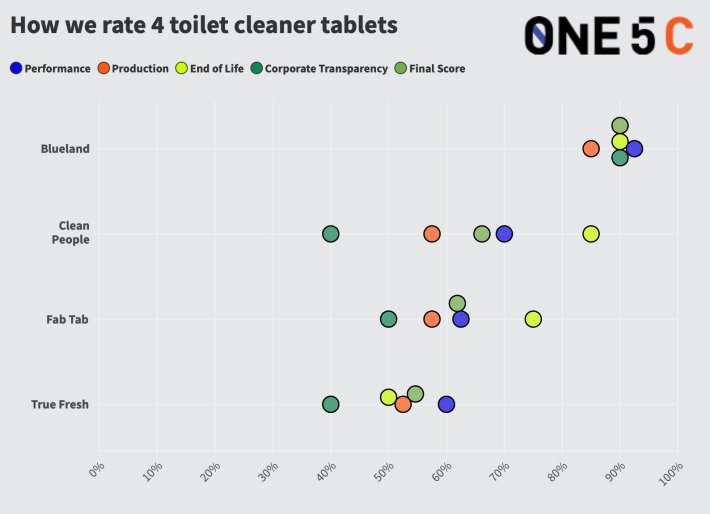
Our product recommendations are based on two parallel assessment tracks: one for performance and one for sustainability. These ratings combine to land on our final winner, which represents the ideal blend of a product that’s good for the Earth and for your life. Read more about our assessment process here.
How we tested toilet cleaner tablets
After unboxing and inspecting each toilet cleaning tablet, we deployed them in a busy, three-bathroom household. Following the manufacturer's instructions—drop the tablet into the bowl, wait for the fizzing to subside, scrub, and flush—we used a long-handled toilet brush for thorough cleaning. To gather a range of opinions on performance, scent, and ease of use, we also enlisted friends and houseguests to try the tablets themselves on messes of varying intensity. In addition to real-world use, we conducted the following controlled tests:
- Dissolvability test: We dropped each tablet into a toilet and timed how long it took to dissolve, noting how completely it broke down and whether any residue remained.
- Hard water test: To simulate the tough limescale buildup common in many households, we created a mineral deposit solution using calcium chloride, Epsom salt, and water. We applied it to the toilet bowl and accelerated the hardening process with a hair dryer. Then, we assessed how effectively each tablet removed the artificial limescale.
- Peanut butter test: To mimic stubborn grime in hard-to-reach areas, we applied two tablespoons of peanut butter (extra chunky) along the sides and into crevices of the bowl. After letting the smear dry, we cleaned the toilet using each tablet and a standard brush, evaluating how well the tablets dissolved the mess and the amount of scrubbing required.
- Deodorizing test: We introduced one tablespoon of distilled white vinegar into the toilet to simulate an unpleasant odor and allowed it to aerate for 30 minutes. We then used each tablet to clean the bowl and evaluated how well it neutralized the smell.
How we scored sustainability
Our sustainability ratings take into account three factors: a product’s environmental impact at its production, what happens at its end-of-life, and the manufacturer’s environmental behavior. Production factors in where, how, and with what raw materials a product is made—as well as how it’s transported through the supply chain. End-of-life considers any potential toxicity as well as what happens to the product’s packaging once the powder’s gone. The final factor involves actions the company takes outside the life of a product to minimize its footprint or benefit the environment, and we award bonus points for transparency, as well. These scores are informed inferences based on available information, not full-blown life-cycle analyses.
How Blueland Toilet Bowl Cleaner Tablets performed
The plumpest, most-active tablets of the bunch, Blueland’s Toilet Bowl Cleaner Tablets ($18 for 14; blueland.com) were the clear standout across every test we ran—outperforming all other brands by a noticeable margin. These chunky, silver-dollar-sized tablets fizzed vigorously on contact and dissolved completely without leaving behind any flakes or residue.
Blueland's stabs made quick work of everything we threw at them: simulated hard water stains, everyday grime, and dried peanut butter. Once the tablet finished fizzing—a process that took about a minute and a half, on average—most messes required only a light scrub to lift off the porcelain. The lemon-cedar-scent (Blueland also sells a peppermint-eucalyptus option) was universally loved by testers; it not only deodorized effectively but also left behind a crisp, natural smell without overpowering the space.
Unfortunately, we couldn’t say the same for the Fab Tab Toilet Cleaners ($30 for 30 tablets; fabtab.com) and the True Fresh Toilet Bowl Cleaner ($20 for 24 tablets; true-fresh.com). Both tablets had a strong synthetic odor to them: True Fresh’s “ocean breeze” made one tester’s eyes water and was widely disliked for its fake smell, and Fab Tab’s lemon-eucalyptus leaned unmistakably toward “cleaning-product lemon,” as opposed to real citrus. While both tablets dissolved in about 30 seconds, they each left faint, gritty residue on the bottom of the toilet—not a big deal but noticeable, nonetheless. They did a fine job dislodging grime, but we had to use more elbow grease during the peanut butter test with both.
Nothing’s perfect: Blueland’s tablets are extra-large and come unwrapped, so they can flake a bit when they bump into one another in the bag. Much like with the company’s dishwasher tablets (also a winner), a few tablespoons’ worth of powder piled at the bottom of the pouch. They also took the longest to dissolve, which makes sense given that they were the heftiest of the options we tested. At about $1.29 per tablet, they’re also the most expensive, but the price dips to $1.03 per tablet if you subscribe for regular deliveries.
Why Blueland Toilet Cleaner Tablets are sustainable
In terms of planet-friendliness, there aren’t a lot of boxes Blueland’s tablets don’t check. They’re free of VOCs, parabens, phthalates, ammonia, and bleach. Plus: The company specifies every item on the ingredients list, including where its fragrances come from, which not all the competitors do. (The pleasant citrus zing is thanks to an essential oil from lemongrass plants, for example.) The tabs also enjoy the full suite of eco certifications, including EPA Safer Choice (non-toxic), Cradle to Cradle (environmental and health consciousness), and Leaping Bunny (cruelty-free). They’re also the only tablets on our roster that aren’t individually wrapped, which cuts down on packaging waste—namely of the plastic variety.
Blueland’s also buttoned-up from a climate POV at the company-wide level. It’s Climate Neutral certified, meaning it actively tracks and cuts its emissions. The firm’s zeroed out nearly all its Scope 1 and Scope 2 greenhouse gases (the emissions from its operations and energy use, respectively), and has a range of plans in motion to trim Scope 3 outputs (the gases emitted throughout its entire supply chain). They, for instance, worked with a manufacturing partner to transition to 100% renewable energy.
Nothing’s perfect: We’ve pointed this out in prior reviews, but it’s worth noting that Blueland does reach its emissions goals partly through the use of carbon credits—a fraught enterprise, to put it mildly. We appreciate, though, that the company does some extra vetting of the projects it funds, including its investment in capturing ozone-depleting hydrofluorocarbons. Any other nits we have to pick here are small, but in case you’re wondering: While the bag the tablets come it is compostable, that applies only to industrial setups, not your average backyard heap.
The runner up: Clean People Toilet Cleaner Tablets
Clean People Toilet Cleaner Tablets ($24 for 24; cleanpeople.com) are aggressively fine. They dissolved quickly, produced a decent amount of fizz, and tackled hard water, peanut butter, and general life stains without much issue. The lemon verbena scent (these are also available in citrus clove and coconut vanilla) wiped out the vinegar smell, but was still quite light and disappeared quickly post-clean. At a buck a piece, they’re about $0.30 less than Blueland on a per-tablet basis (if you don’t go with Blueland’s subscription offer), and they also come in a larger pack, meaning you don’t have to purchase them as often.
Aside from publishing a full ingredients list—all nice and clean!—there’s little in the way of transparency from Clean People as a company. They claim the tablets are cruelty-free, but there’s no Leaping Bunny or other certification to back that up. They also don’t publish any info about their emissions, water stewardship, or energy consumption—let alone plans to manage them—and didn’t respond to our requests for more info. Not to pile on, but Clean People's tablets are also individually packaged in plastic.
Matt Berical is Senior Editor at one5c and a longtime writer and editor based in Richmond, Virginia.
Corinne Iozzio is the Editor-in-Chief of one5c, and an award-winning science and tech editor with more than 15 years of experience.
one5c does not earn a commission on any product purchased through our reviews.