
We blow, wipe, dab, and crumple our way through a staggering amount of tissues. The U.S. accounts for the biggest share of the 45.6 million tons of tissues produced every year. Yet, just like toilet paper and paper towels, most of those soft little squares come from freshly cut trees: About 68% of all facial tissues are made from virgin wood pulp, which is a bummer considering they’ll spend mere seconds on your face before landing in the trash.
But there are better options out there. There’s bamboo, which, thanks to its ultra-fast growth rate and ability to regenerate without replanting, has emerged as an alt-wood golden child. It also makes for some soft tissues. In terms of environmental impact, however, it’s always bested by recycled paper, which typically demands significantly less water and energy than virgin pulp and produces around one-third of the carbon.
If you’ve ever wiped your nose with something that felt like a pumice-stone on already tender skin, though, you know many eco-friendly tissues aren’t fit for handling your sniffles. To find the best option, we put six brands to the test: three made from bamboo and three made from 100% recycled paper.
We evaluated comfort, durability, and softness—alongside the climate impacts of their raw materials and the planetary stewardship of the companies who make them. In the end, we found tissue that’s gentle on your face without being harsh on the planet.
one5c’s pick: Who Gives a Crap 100% Bamboo Facial Tissues

Strong enough to endure serious nose-blowing sessions yet soft enough to treat schnozzes kindly, Who Gives a Crap’s 100% Bamboo Facial Tissues ($22 for 12 boxes; whogivesacrap.com) aren’t just good sustainable tissues—they’re good tissues. Full-stop. The three-ply sheets don't shed, sustain an impressive amount of weight before tearing, and are absorbent enough to keep contents where they belong. While they placed third in performance behind our two other bamboo contenders, Who Gives a Crap ascended to first place overall based on the company’s sustainability efforts. The bamboo they harvest comes from responsibly managed sources, their packaging (including shipping boxes) is made from 100% recycled paper, and they’re continually working with their manufacturing partners to up their mix of renewable energy.
Runner-up: Rosey by Thrive Market 100% Recycled Facial Tissues
Rosey by Thrive Market’s 100% Recycled Facial Tissues ($3.98; thrivemarket.com) were the sleeper hit of the recycled bunch. They’re softer than you expect from a recycled sheet, with sturdiness and comfort that rival many bamboo options—even if they are slightly less durable. Rosey handled everyday sniffles gracefully and offered the best balance of softness-to-sustainability in the recycled lineup. Thrive Market is also the most buttoned-up company we looked at in terms of planetary stewardship: Not only are the tissues made with 100% post-consumer paper, but the company has also earned a Climate Neutral certification. If bamboo isn’t your bag, Rosey is a stellar choice.
What sustainable tissues we tested
We selected a mix of 100% bamboo and 100% recycled tissues that were widely available, well-reviewed, and offered a good taste of what the average shopper would come across on the virtual or physical shelves. The tissues we tested were:
- BimBamBoo 100% Bamboo Facial Tissues
- Reel 100% Bamboo Facial Tissues
- Rosey by Thrive Market 100% Recycled Facial Tissues
- Seventh Generation 100% Recycled Facial Tissues
- Simple Truth 100% Recycled Facial Tissues
- Who Gives A Crap 100% Bamboo Facial Tissues
How we picked the best sustainable tissues
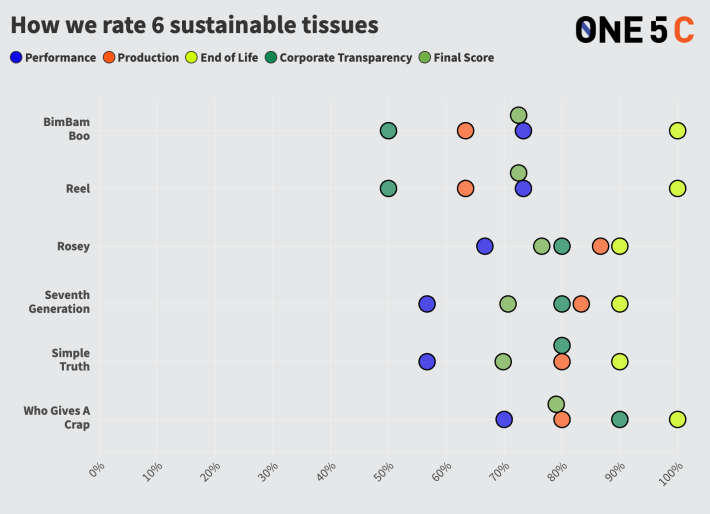
Our product recommendations are based on two parallel assessment tracks: one for performance and one for sustainability. These ratings combine to land on our final winner, which represents the ideal blend of a product that’s good for the Earth and for your life. Read more about our assessment process here.
How we tested sustainable tissues
We used all six contenders over several weeks to handle daily sniffles, allergy season eye-dabbings, and general home use. We looked at little things, too, including whether or not the tissues were easy to grab from the box and how much they shed. We also submitted each one to a series of graded tests:
- Absorbency test: We weighed a dry sheet, dunked it in 3 milliliters of water for 5 seconds, let it drip for 5 more, then weighed it again to measure how much it absorbed.
- Strength test: We hung a dry sheet between two stacks of books and added pennies to the center, recording how many it could support before tearing.
- Softness test: We had a group of 10 testers blindly use all tissues and rate their softness on a score of 1-5. We then tallied the average of all the scores.
How we scored sustainability
Our sustainability ratings take into account three factors: a product’s environmental impact at its production, what happens at its end-of-life, and the manufacturer’s environmental behavior. Production factors in where, how, and with what raw materials a product is made—as well as how it’s transported through the supply chain. End-of-life considers any potential toxicity, like, in the case of paper products, the presence of formaldehyde or chlorine-based bleach. The final factor involves actions the company takes outside the life of a product to minimize its footprint or benefit the environment, and we award bonus points for transparency, as well. These scores are informed inferences based on available information, not full-blown life-cycle analyses.
How Who Gives A Crap Bamboo Tissues performed
Who Gives A Crap’s 100% Bamboo Facial Tissues ($22 for 12 boxes; whogivesacrap.com) hit a rare sweet spot in our testing: soft enough to be comfortable on the nose, but strong enough to handle multiple blows. They placed third overall in performance, but only by the slimmest of margins behind BimBamBoo 100% Bamboo Facial Tissues ($32 for 6 double boxes; bimbamboopaper.com) and Reel 100% Bamboo Facial Tissues ($50 for 24 boxes; reelpaper.com). All tissues scored well.
For something you’ll reach for dozens of times when you’re living through a cold or allergies, absorbency goes a long way. Who Gives A Crap soaked up nearly its full weight in liquid without sagging or collapsing. That put them near the top of the heap, while Simple Truth 100% Recycled Facial Tissues ($2.49; kroger.com) and Seventh Generation 100% Recycled Facial Tissues ($4; grove.co) each absorbed less than their own weight.
If a tissue can’t stand up to a real honkin’ blow, you’ll end up doubling up to keep germs contained, which defeats the purpose of opting for a more sustainable option. Again, Who Gives A Crap’s sniffle-stoppers held their own. They were the third most-durable of the bunch, able to hold the weight of 17 pennies before collapsing, ranking slightly behind BimBamBoo and Reel but ahead of all recycled options. Simple Truth fell apart under a moderate load of 11 pennies before tearing, and Seventh Generation managed 13. All of them scrubbed well, but the bamboo options were able to survive more wipes without splitting or shedding.
Who Gives A Crap was also one of the softest tissues tested. Our panel of 10 ranked it the third softest behind recycled Rosey and bamboo-based Reel. A single tissue might not be Puffs-level cloudy, but it was gentle enough for repeated nose-blowing—a stark contrast to Simple Truth and Seventh Generation, which felt a bit stiffer.
Nothing’s perfect: Even with their strong all-around performance, Who Gives A Crap’s tissues had a few quirks worth noting. They were slightly tougher to pull from the box than some of the recycled options, which made the first few sheets stick together, and some testers thought they were a touch rough on the ol' honker.
Why Who Gives A Crap Bamboo Tissues are sustainable
The gold standard for paper products is recycled materials, but if you’re gonna wipe your snot with any freshly-grown material, bamboo is the smarter choice. Like all three bamboo-based tissues we looked at, Who Gives A Crap’s are made from 100% FSC-certified panda food, meaning they come from responsibly managed sources. Their packaging—including both the shipping cartons and the tissue boxes themselves—is made from recycled materials, and the company says the majority of that is from post-consumer sources like old newspapers. Like all the tissues in our field, they’re whitened with a chlorine-free bleaching process and are free of formaldehyde and other nasties that can crop up in some commercial nose-wipers.
That’s all great, but Who Gives A Crap’s corporate enviro-commitments are really what helped them beat BimBamBoo and Reel on the podium. They’re a high-ranking B-Corp, with particularly strong marks in resource conservation. While their emissions have gone up as the business has grown, a spokesperson told us they’re focusing on untethering the two by addressing the planet-warming potential of manufacturing and transportation. One example: Their tissues are made in China, a country whose energy mix is heavy on fossil fuels like coal; currently, the factory is partially powered by solar energy and the company is working to get that portion up to 50% in 2026. Also nice: Who Gives A Crap donates a big chunk of its profits expanding global access to clean water and toilets.
Nothing’s perfect: Who Gives A Crap touts its carbon-neutral shipping, but decarbonizing transportation is a sticky wicket here. The company only manages only 11% of its delivery fleet, which means its ability to trim emissions there is minimal. A portion of orders in Australia and the U.K. are couriered in electric vehicles; the rest gets zeroed out via offsets. Offsetting planet-warming gases is, of course, no replacement for not emitting in the first place—but the company seems to get that.
The runner-up: Rosey by Thrive Market 100% Recycled Facial Tissues
No, they’re not the cushiest tissues you’ve ever blotted your nose with, but Rosey by Thrive Market’s 100% Recycled Facial Tissues ($3.98; thrivemarket.com) did tie for the softest snot-stoppers we looked at. Against everyday sniffles, allergy season sneezes, and random face-blotting, Rosey held up well, making it the standout recycled option in the lineup. They were, however, the least durable of the bunch—breaking under just 9 pennies of weight—and they’re also the least accessible. Rosey is the in-house brand of Thrive Market, which means to purchase them you’ll have to pony up for a membership.
Rosey tissues earned the silver medal because they are the least rough on the planet of all the options we looked at. They’re made entirely from recycled materials in North American factories, use a non-chlorine bleaching process, and contain no potentially toxic or harmful chemicals. Thrive is also a B-Corp with a well-above-average score, has earned a Climate Neutral certification, and is working with its suppliers on emissions-reduction targets. That last bit is especially good news considering that those emissions account for around two-thirds of the company’s total—and that they’re relying on offsets in the meantime.
Matt Berical is Senior Editor at one5c and a longtime writer and editor based in Richmond, Virginia.
Corinne Iozzio is the Editor-in-Chief of one5c, and an award-winning science and tech editor with more than 15 years of experience.
one5c does not earn a commission on any product purchased through our reviews.