
Google “how many razors go to the landfill each year?” and you’ll land on dozens of articles citing an EPA stat from the 1990s saying billions of pieces of shaving waste hit the dump every year. That number might be aged and iffy, but you don’t need to do much more than walk down the grooming aisle at your local CVS to sense that it’s not exactly overblown.
Those flashy, plastic-y, multi-blade shavers aren’t only bad news for the planet; They can also be murder on your dermis. If you’ve got sensitive skin, more blades can mean more irritation. They can also lead to annoying in-growns.
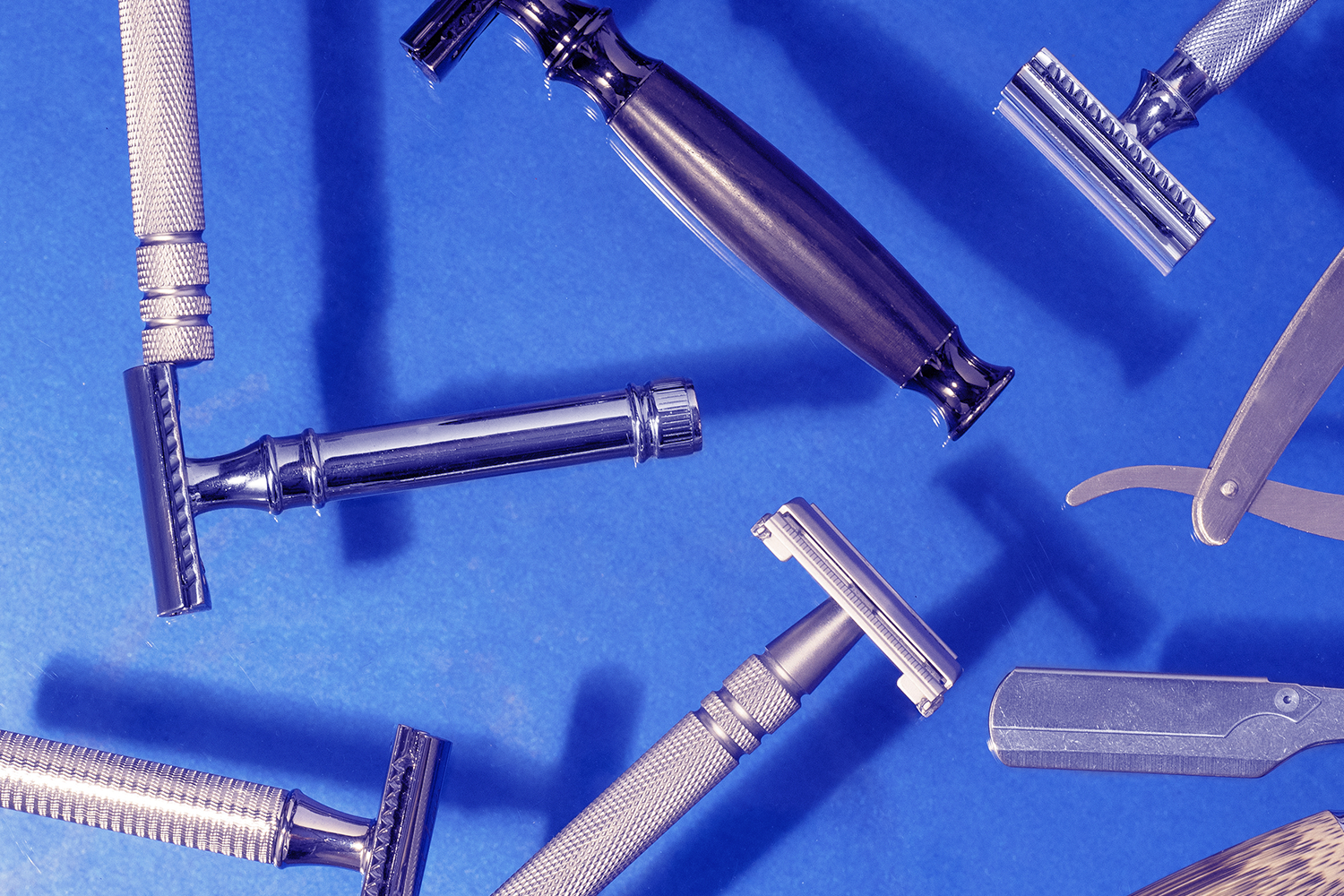
It’s no surprise, then, that the humble safety razor has been mounting a comeback. For the unfamiliar: The simple shaving tools sandwich a single stainless-steel blade between a pair of metal plates, holding it at just the right angle to snip hairs without slicing your skin.
If you’re used to shaving with store-bought cartridges or disposables, a safety razor could take some getting used to. (Check out a beginner’s guide like this one to get started.) Once you’ve got the technique down, though, a single razor should last a lifetime, and replacement blades can cost $1 or less a piece. Collect spent blades in an old coffee can, Altoids tin, or readymade receptacle called a blade bank, and take ‘em to a scrapper or recycler once it’s full.
Could any safety razor help save money, skin, and the planet? Sure, probably. But is there one that stands out from the rest? To find out, we got cozy with four top entry-level models and dug into the sustainability practices of the companies who make them. The winner delivered baby-smooth skin, was easy to use, and won’t tear the Earth to shreds.
one5c’s pick: Edwin Jagger DE89 Double Edge Safety Razor
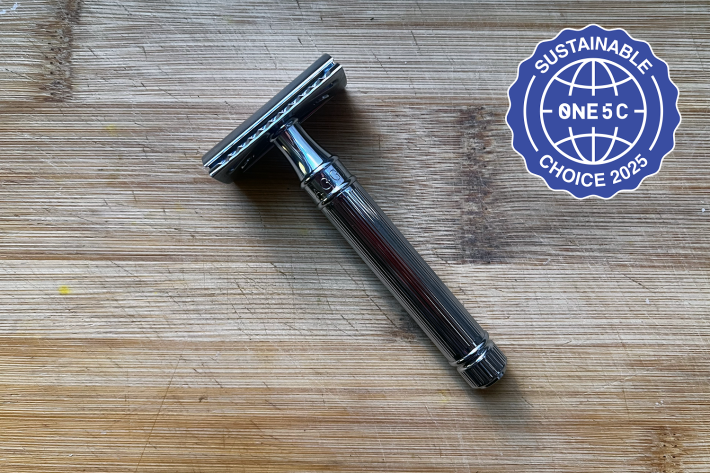
The Edwin Jagger DE89 Double Edge Safety Razor ($46.50; amazon.com) edged out its competition thanks to its close shave and simple blade-swapping routine. It guided the razor’s edge smoothly across skin without any nicks or cuts—including in delicate areas like the deep nooks behind knees. Its twist-off head made replacing the blade easy, even for a safety-razor beginner with less-than-perfect dexterity. It withstood abuse, including sitting in a salt-water spritz, without any signs of wear, but the U.K.–based company does offer replacement parts if something goes awry.
The runner-up: King C. Gillette Double Edge Safety Razor
The modern iteration of the OG safety razor, which Gillette patented in 1901, the King C. Gillette Double Edge Safety Razor ($35; gillette.com) lives up to its ancestry. Its shave is smooth—though not the butteriest of the bunch—and trading out blades isn’t the least bit finicky. This safety razor slid in to second place on the strength of emissions-reduction goals from Gillette’s parent company, Proctor & Gamble, which the firm verified through the Science-based Targets Initiative.
What safety razors we tested
There are hundreds of safety razors in the marketplace, so we narrowed our test to models that are good entry points for newbies. They’re all well-reviewed, easy-to-find, and cost less than $50. We focused on models with “closed-comb” designs, which have a flat safety bar beneath the blade that helps hold skin taut—a good setup for beginners.
- Edwin Jagger DE89 Double Edge Safety Razor
- King C. Gillette Double Edge Safety Razor
- Merkur 34C Double Edge Safety Razor
- Parker 99R Safety Razor
How we picked the best safety razor
Our product recommendations are based on two parallel assessment tracks: one for performance and one for sustainability. These ratings combine to land on our final winner, which represents the ideal blend of a product that’s good for the Earth and for your life. Read more about our assessment process here.
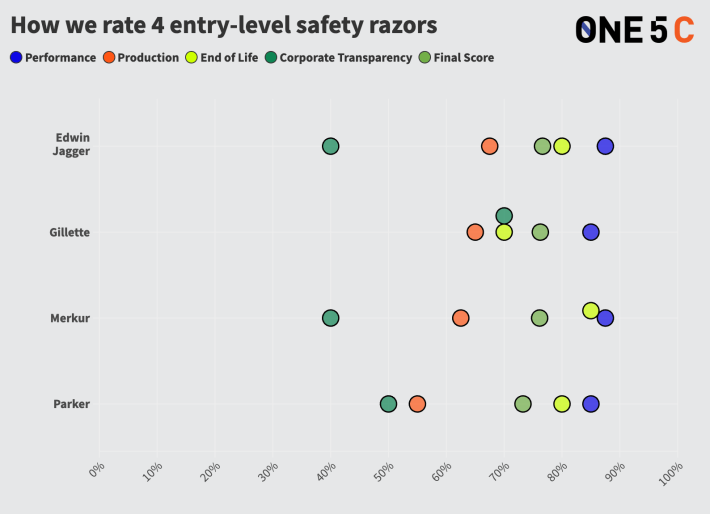
How we tested safety razors
Over the course of several weeks, we used all four razors as part of normal shaving routines, which include curvy areas like ankles and underarms and tricky nooks like the sides of the neck and behind the knees. Our testers—both lady and dude—scored each on how easy (or hard) it was to swap the blades, how comfortable they were in-hand, and the feel and closeness of the shave.
Given that these hair-removers are meant to last a lifetime, we designed a couple tests to simulate the conditions they’d face over long-term use. To see how well the metal would hold up to years of mineral buildup from tap water, we spritzed the field with a salt-water solution and sealed them in a container for two hours. We followed that up with a blast of soapy water meant to act like shaving foam residue, and let that sit again. Once the torture session was through, we checked each razor for signs of corrosion, like discoloration or surface roughness.
How we scored sustainability
Our sustainability ratings take into account three factors: a product’s environmental impact at its production, what happens at its end-of-life, and the manufacturer’s environmental behavior. Production factors in where, how, and with what raw materials a product is made, as well as how it’s transported through the supply chain. End-of-life considers any measures the company has in place to keep products in good working order—like offering replacement parts—and anything they do to make blade recycling easier. The final factor involves actions the company takes outside the life of a product to minimize its footprint or benefit the environment, and we award bonus points for transparency, as well. These scores are informed inferences based on available information, not full-blown life-cycle analyses.
How the Edwin Jagger DE89 performed
In our tests, only the razor-thinnest of margins separated the pack. The Edwin Jagger DE89 Double Edge Safety Razor ($46.50; amazon.com) went neck and unnicked neck with the Merkur 34C Double Edge Safety Razor ($49.99; merkurshave.com) in terms of shaving performance. We were equally happy with how each one glided across skin—no catching, snagging, or uncomfortable friction. The finished shaves were close and smooth, and didn’t require multiple or excessive passes to get the job done. Neither one drew blood.
All the safety razors in the field survived our attempts at accelerated corrosion. As entry-level models, they all feature chrome plating atop a durable metal base—usually brass. Exposed brass tarnishes over time; while that doesn't weaken the metal, plating that wears off too quickly or easily can tip shoddy craftsmanship. Pricier safety razors (i.e., not the ones in this bunch!) are typically made with tougher stuff like stainless steel.
Day-to-day usability shouldn’t be an issue with any of these razors, either. While we found the shave with the Parker 99R Safety Razor ($32; supersafetyrazors.com) the bumpiest of the lot, it did have the simplest blade-trading routine: It features a butterfly-style head that cranks open with a twist of the handle. That’s not to say Edwin Jagger made swapping the blade hard, but it wasn’t quite as easy. The shaver uses a common three-piece design: a handle, a base plate the blade sits on, and a top cap which screws down to hold the edge in place.
The parts hand-tighten together easily by twisting the head into the handle. And, try though we might, we weren’t able to overtighten the assembly—which would be bad news for the longevity of the threads, but also for the precise angle of the blade. This ease is what separated Edwin Jagger from the Merkur 34C, which was the trickiest to put together; its two-piece assembly fixes the base plate to the handle, an arrangement that requires you to balance the blade in position before twisting on the handle. The less-dexterous of our testers found the process a little shaky, particularly when a sharp edge is involved.
Nothing’s perfect: There are a couple issues with the Edwin Jagger DE89 worth considering, though neither are deal-breakers. If you’re new to the safety razor game, swapping blades might make you a tad nervous—at least at first. You have to grip the head in order to loosen it from the handle, which means being careful to grab it on its short ends to avoid pressing your fingertips against the sharp blade. We also found the texture on its handle slightly less grippy than the tighter knurling on other razors, which made it a bit slippery when wet.
Why the Edwin Jagger DE89 is sustainable
Given that a good safety razor should be able to outlive its owner, we were happy to see that Edwin Jagger backs up its workmanship. All its razors are covered by a one-year warranty against manufacturing defects. The company also sells replacement parts, so if one piece goes missing or breaks you don’t have to start over. Also worthy of appreciation: The company says that its packaging—all paper and cardboard, by the by—is made from 80% recycled materials.
Edwin Jagger also operates its own manufacturing facility in the U.K., which has allowed it to make efficiency adjustments like cutting production from five days a week down to four. That’s extra-good news considering that the U.K. currently gets about 47% of its energy from renewable sources.
Nothing’s perfect: While we love that the company is driving towards greater manufacturing efficiency, Edwin Jagger—along with Parker and Merkur—is a bit of a black box on the sustainability front. It’d be swell if it was more forthcoming about the particulars of its overall energy consumption and the progress it’s made to dial that back. We’d also like more transparency into how it sources materials and tracks water usage at its production facilities.
The runner-up: King C. Gillette Double Edge Safety Razor
As the regent of safety razors, the King C. Gillette Double Edge Safety Razor ($35; gillette.com) lives up to its lineage. Though it didn’t deliver quite as glide-tastic of a shave as Edwin Jagger or Merkur—a couple nicks when navigating around bony spots knocked it from the top spot—it did cut close and leave our skin smooth without any uncomfy friction. This safety razor uses a three-piece design, so swapping blades works the way it does on the Edwin Jagger, and the same finger-saving caveats apply.
On the Earth-friendly front, Gillette scored highest in the pack, but it is still a bit of a mixed bag. Details are scarce around the production of the razor itself, including what base metal is underneath the chrome plating, but we do know that the company manufactures its shaver in China—a country with an energy mix that’s still pretty heavy on coal. Also a bummer: There’s no warranty to speak of covering the razor, and we couldn’t find any available replacement parts.
The upside of being owned by a big outfit like Proctor & Gamble, though, is that there’s greater ability to throw corporate weight behind environmental programs. The company, for example, has made good on its promise to switch to predominantly recycled content in its paper packaging, and has emissions-reduction goals that are rubber-stamped by the Science-based Targets Initiative. It’s also the only company we looked at with efforts underway to trim water usage on its production lines.
one5c does not earn a commission on any product purchased through our reviews.