

This review has been updated. It originally published on Sept. 19, 2024.
The sealable, single-use plastic bag is as much a staple of the home kitchen as a frying pan or set of tongs. They function as snack transporters, marinating vessels, and leftover storers. So ingrained are these bags in American homes that a single household uses upwards of 500 per year. That’s a lot of bags—and a lot of plastic waste added to the already horrific amount that clogs and pollutes our land, waterways, and even our bodies.
As we all work to trim our ration of single-use plastic, reusable food-storage bags are a no-brainer. In a lot of ways, they’re actually on another level: Sure, they’ve got familiar press-and-seal closures, can tuck easily in any fridge, freezer, pantry, or lunch box, and have firm-yet-flexible forms that make it simple to, say, massage in a marinade. But many of them are also oven- and microwave-safe and have wide, flat bottoms so they can stand sturdily upright for filling or fridge placement.
Reusable food-storage bags are a simple, practical swap for their flimsy plastic brethren—if they work. You need to use a bag a lot to have a shot at reaping its enviro-benefits. And there are plenty of options available. But which is worthy of a spot in your kitchen drawer? We put five popular models through a series of five seal-stressing tests and dug into their sustainability stories to find the one that offers an ideal balance of performance and Earth-friendliness.
one5c’s pick: Ziploc Endurables
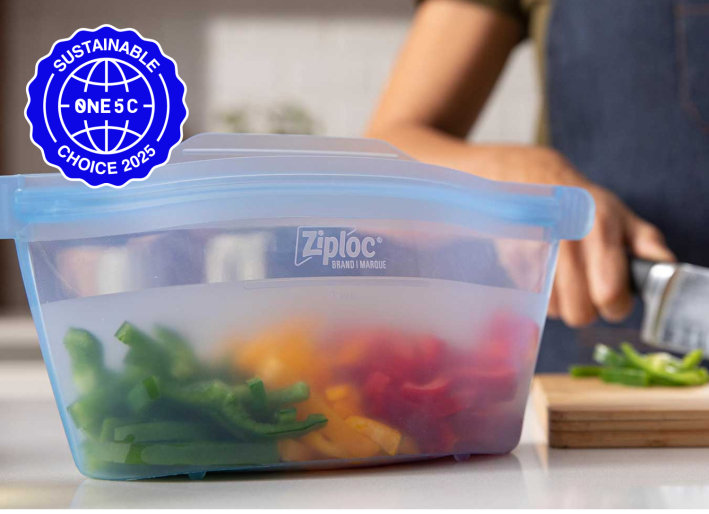
We found ourselves reaching for Ziploc’s Endurables ($45, 5-bag variety pack; amazon.com) even after our official testing window closed. They’re strong and flexible, easy to fill and clean, and full of thoughtful features like wide mouths and a set of grippy, heatproof tabs that keep your fingers safe when you’re grabbing them from the microwave. But what really pushed them over the top was their exceptional seal, which stayed tight even after a lot of mistreatment. While their manufacturer, SC Johnson, is far from environmentally benign, the firm did shore up the Endurables’ life cycle, including making the bags at a 100% wind-powered plant and offering a potential pipeline to reuse materials once the bags are spent.
The runner-up: Stasher bag stand-up trio
Performance-wise, the Stasher Bag Stand-Up Trio ($78; stasherbag.com) tied for third place. They did fine overall, but their seal wasn’t as reliable as Ziploc’s, their thicker material is a bit difficult to manipulate, and their narrow openings are a bit awkward to fill. They did, however, stand out from the pack in terms of sustainability: The pouches are made from super-stable silicone, free of BPAs and phthalates, and the company is part of 1% for the Planet, an org that helps them donate a portion of profits to environmental causes.
What reusable food storage bags we tested
Similar to the baggies in your drawer, reusable food-storage bags come in a range of sizes, from snack pouches to freezer-sized gallon bags. Most companies offer two form factors: floppy models and more-structured vessels with wide bottoms that stand upright. The floppier ones are best for dry snacks and things like fruit slices, while the container-style ones are more suited for leftovers and soupier foodstuffs. We evaluated each.
The all-in prices vary depending on how you mix and match, but expect to drop in the $50-$80 range for an initial kit of 3 to 5 bags. All the vessels have press-to-seal closures, come in a range of sizes and colors, and are all easy to purchase.
- Stasher Bags Stand-Up Trio as well as the Reusable Sandwich Bag
- (Re)Zip 3-Piece Stand-Up Kit and Half Gallon (Deli) Bag
- W&P Reusable Bag Starter Set
- Ziploc Endurables Large Pouch, Medium Pouch, and Medium Container
- Zip Top Reusable Bag 2-Set and snack bag
A quick PSA before we go further: None of these bags are blissfully plastic-free. The majority are silicone, which is a polymer made by reacting silica with hydrocarbons. Think of it kinda like a hybrid that’s mostly synthetic rubber and some plastic. The material’s super durable, so it’s less likely to release microplastics at high temps; that doesn’t stop it, however, from shedding bits and pieces if it meets the pointy end of a knife or tooth or blender blade. Some bags, like (Re)Zip, are made from PEVA—that’s ethylene-vinyl acetate, which is straight-up plastic.
How we picked the best reusable food storage bags
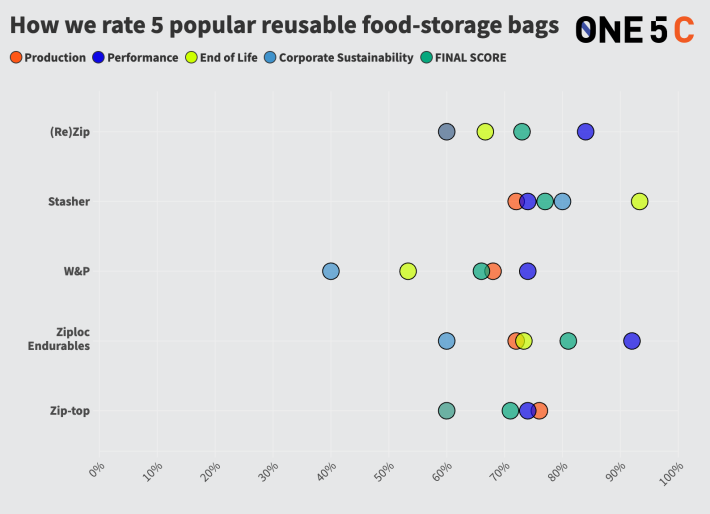
Our product recommendations are based on two parallel assessment tracks: one for performance and one for sustainability. These ratings combine to land on our final winner, which represents the ideal blend of a product that’s good for the Earth and for your life. Read more about our assessment process here.
How we tested reusable food storage bags
We spent a few months with each variety of bag, using them in place of single-use baggies for marinating, storing leftovers, transporting snacks, freezing surplus food, and more. We kept notes on the more general stuff like how easy (or not) they were to store in a drawer or cabinet and how they tucked into a lunch box. We also performed the following graded tests:
- Fill and seal test: We ladled a cool marinara sauce into each bag, shoved them into a full fridge to see how their seals handled sliding in and out and around, and then shook the sauce-filled bags upside down for 60 seconds.
- Drop test: We filled each bag with water and dropped them from the countertop to the floor—roughly 4 feet—five times to simulate an accidental fall.
- Freshness test: We pressed the air out of the bags and stored a selection of washed, dried, paper towel-wrapped spinach greens in each for three days.
- Cleaning test: We let each bag fester in the fridge filled with marinara sauce and a chili-paste-ginger marinade for two days before running ’em in the dishwasher.
- Freezer test: For the final hurdle, we placed each bag—filled with cooked lentils and with as much air pushed out as possible—on ice for two days and then checked for ice crystals.
How we scored sustainability
Our sustainability ratings take into account three factors: a bag’s environmental impact at its production, what happens at its end-of-life, and the manufacturer’s environmental behavior. Production factors in where, how, and with what a product is made—as well as how it’s transported through the supply chain. End-of-life factors in the bag’s secondary uses, if and how it might be recycled, and any potential toxicity it might create should it reach the landfill. The final factor accounts for actions the company takes outside the life of a product to minimize its footprint or benefit the environment—we award bonus points for transparency, as well. These scores are informed inferences based on available information, not full-blown life-cycle analyses.
How Ziploc Endurables performed
Ziploc Endurables ($45, 5-bag variety pack; amazon.com) are a line of BPA- and phthalate-free silicone bags designed for storage as well as prep and cooking. They come in two different versions: pouches and containers. The pouches are floppy, meant to lie flat, and available in large (8-cup), medium (2-cup), and small (1-cup). The containers are designed to stand up, with a flat, football-shaped bottom that has a pair of small round feet on each end for extra stability; they’re available in two sizes, medium (4-cup) and small (2-cup). Both versions feature a substantial, pinch-to-seal zipper top as well as clever tabs on the top edges designed for safely handling a just-heated bag. They’re freezer safe, microwave safe, and oven safe to 425 degrees F, and can go on either the top or bottom rack of the dishwasher.
The Endurables won us over—and aced pretty much every test we threw at them—thanks to their incredibly tight seal and soft-yet-structured design. The container version stands up on its own and has a bit more rigidity, so it’s easier to fill with liquids and soupy things. But both form factors open generously and seal tightly. Even after shaking and dropping, the seal stayed strong with zero leakage.
The bags’ soft, flexible structure made it easy to press air out, which helped keep greens wilt-free and sandwich halves from going stale. Staying buttoned up tight also kept a lentil ragu and other contents free of freezer burn when we put leftovers in cold storage. The bags also didn’t smell or stain after snuggling in the fridge for three days, despite holding a gochujang-ginger marinade and very garlicky marinara sauce. Microwaving steamed vegetables, reheating leftovers, and cooking potatoes sous vide were also all straightforward, spill-free endeavors.
Nothing’s perfect: Part of what makes the seals hold so well is that they have an extra-wide track, but that crevice is also the perfect place for bits of food to hide. Successfully dislodging that schmutz required some attentive scrubbing. Also, the pouches are a bit awkward to store in the fridge compared with the containers; their lack of a proper caboose means they need to lie flat or be propped up.
While the bags clean well, they’re not meant to be flipped inside out for risk of tearing—though this is true for every vessel we tested, save the W&P Reusable Bag Starter Set ($75; wandp.com). We also wish they were offered in a few more sizes. In our ideal setup, we’d have a combination of pouches and containers at home: containers mainly for the storage of leftovers, and pouches for snacks, uncooked veggies, and other such items.
Why Ziploc Endurables are sustainable
Ziploc’s Endurables food-storage bags and pouches are made with platinum silicone, which is a level up from conventional food-safe silicone. It tends to be more flexible and easier to clean, which means it makes for better, longer-lasting products. Though that’s not what sets the Endurables apart (containers we tested from Stasher and Zip Top are also platinum silicone): The line is made in SC Johnson’s facility in Bay City, Mich., which runs on 100% wind energy.
The company has also tried to keep spent bags out of the landfill. Though silicone is recyclable, most municipal facilities aren’t set up to handle it. You can hunt down a recycler online, or you can opt to use SC Johnson’s pipeline, which works through Terracycle. The latter isn’t exactly a guarantee of a second life, though: Terracycle aims to collect hard-to-recycle stuff like silicone and product packaging and repurpose it into new products, but has come under scrutiny as an avenue for greenwashing and some of what it takes could sit in a warehouse instead of getting reborn. Terracycle has drop-off locations at a range of retailers, but SC Johnson’s relationship lets owners mail in their bags for free from anywhere in the U.S.
Nothing’s perfect: While we do give SC Johnson credit for buttoning up the Endurables product line, that doesn’t exist in a vacuum. We’d be remiss if we didn’t point out that the company behind our pick is the same one that fed into the baggie bonanza in the first place.
Though we appreciate that the Endurables are made in a plant powered by renewable energy, SC Johnson operates many other factories in the U.S., China, and the Netherlands. (It’s also not as if the throwaway baggies or Windex in single-use spray bottles are suddenly disappearing from shelves.) Generally, products from huge conglomerates like this have a long way to go on their sustainability journeys due to their scale, use of third-party suppliers, and the standards they hold those suppliers to. SC Johnson’s guidelines, for example, only “encourage” the monitoring of carbon emissions and a commitment to adopting more renewables. Despite these caveats, Endurables’ performance dominance pulled it to the top.
The runner up: Stasher Stand-up 3-Pack
In terms of sustainability, the Stasher Stand Up 3-Pack ($78; stasher.com) are elite, but they tied for third in day-to-day life. Like Ziploc Endurables, they’re made out of platinum silicone and are free from BPAs and phthalates. The company also has a partnership with Terracycle if you choose to go that route. Before they get there, though, Stasher has curated a menu of suggestions about ways to squeeze more life out of the bags if they happen to tear or puncture. The company is also part of 1% for the Planet, a group of businesses that donate a portion of their sales to nonprofits working on environmental causes. SC Johnson bought Stasher in 2019, a move that its founder has said was largely about souping up distribution.
We liked that Stasher’s bags felt sturdier than the competition, but that extra thickness made them harder to fill and manipulate. More, importantly, their seal just wasn’t as strong as Ziploc’s. They opened on two out of five drops from counter height as well as when we shook them. They’re still a good product, however, and a worthy plastic bag replacement.
The budget pick: (Re)Zip bags 3-piece stand-up kit
As of Oct. 21, 2025, a three pack of Stasher’s bags costs nearly $80. That’s expensive. We’d wait for the price to fall, or look into (Re)Zip bags 3-piece stand-up kit ($23; rezip.com) if you need bags now and are on a tight budget.
These bags placed second in day-to-day testing but faltered on sustainability. They’re made from food-safe PEVA, a material that’s often used in shower curtains, and are much thinner and more flexible than those made from silicone. PEVA, though, is pure plastic, which immediately knocks these bags down several pegs of planet-friendliness. They do have a TerraCycle partnership if you want to try to give ‘em another go-around. In terms of feel, they’re the most similar to standard single-use bags and the easiest to store and manipulate. They fared well in testing, but didn’t have as strong a seal as the Ziploc, and some of them tore with extended use.
Matt Berical is a writer and editor based in Richmond, Virginia. Most recently, he was the deputy editor of the parenting site Fatherly for seven years. His work has appeared in GQ, Men’s Journal, Taste, Popular Science, and more.
Lizzie Horvitz is the co-founder of Finch Insights, which assesses the environmental impacts of consumer products. She's worked on climate change mitigation for 18 years in both nonprofit and corporate settings, including at Estée Lauder and Unilever.
one5c does not earn a commission on any product purchased through our reviews.