

Dermatologists have been shouting at us to apply sunscreen for decades, but it took a while for that advice to stick. This is especially true when we’re talking about mineral sunscreens. Though highly recommended by doctors and less detrimental to the environment than their chemical counterparts, mineral formulas have historically been thick, pasty, and embarrassing to wear. Thankfully, offerings have improved, and awareness of sun protection has grown. Skin cancer, after all, is the most common type of cancer, and UV exposure is a prime cause.
But how to choose a sunscreen that protects you, wears well, and is better for the planet—especially when there are tubes everywhere you look? To help you find the best mineral sunscreens, we spent two months testing products under the intense Gulf Coast sun. We evaluated UV protection, application, water resistance, and brand sustainability, from packaging to ingredient sourcing. Our choice for the best sunscreen delivers solid protection and a small footprint.
What to know about mineral sunscreens
Sunscreens generally fall into two categories: “chemical” and “mineral.” Chemical sunscreens work by absorbing the sun’s rays with ingredients such as oxybenzone and octinoxate, which some studies suggest can harm human health and marine life. Mineral sunscreens, on the other hand, sit on top of the skin and physically block UV rays with non-nano (aka those that aren’t so small that they penetrate the skin or harm our waterways) zinc oxide or titanium dioxide—ingredients dermatologists we spoke to consider safer for people and the planet.
Mineral sunscreens, sometimes called “physical” sunscreens, tend to provide broader spectrum protection against greater wavelengths of UV light than chemical options, says Joshua Zeichner, M.D., associate professor of dermatology and director of cosmetic and clinical research at Mount Sinai Hospital. “Zinc oxide has the greatest breadth of protection of the filters currently available in the United States for use in sunscreen,” he says. Mineral sunscreens, he adds, also tend to be less irritating, which is why they’re recommended for people with sensitive skin, says the American Academy of Dermatology Association (AAD).
Of course, you should always consult a dermatologist to see what kind of UV protection is best for you. It’s also important to see a board-certified doc once a year for a full-body skin cancer screening.
one5c's pick: Badger Sport Mineral Sunscreen Cream
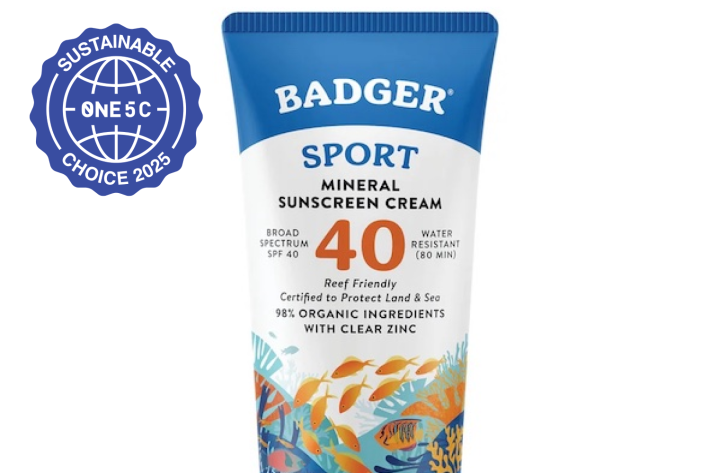
After slathering on several vacations’ worth of sunscreen, Badger Sport Mineral Sunscreen Cream ($18 for 2.9 oz.; badgerbalm.com) earned tester acclaim—and the top spot overall. It absorbs easily into skin without leaving behind a white film. Most importantly, Badger capably protected burn-prone skin from the sun. We also liked that there are only four ingredients, including soothing vitamin E, and 98% of them are organic. The cream, which comes packaged in a 50% post-consumer recycled tube, is made at a LEED-certified 100% solar-powered facility, and the company has a goal to hit net zero emissions by 2030.
The runner-up: Babo Botanicals Sheer Zinc Mineral Sunscreen Lotion SPF 30
Babo Botanicals Sheer Zinc Mineral Sunscreen Lotion ($18 for 3 oz.; babobotanicals.com) performed almost as well as Badger, offering good sun protection, a smooth texture, and a formula that disappeared quickly into skin and didn’t streak after time spent in water. On the sustainability front, it ticks a lot of boxes, and we liked that Babo works to educate consumers about how they comply with Hawaii’s sunscreen regulations and why some companies’ biodegradability claims are often B.S.
What sunscreens we tested
We spent weeks researching mineral sunscreens and selected 10 options that provided broad-spectrum protection with an SPF of 30 or higher—the level recommended by dermatologists. Test sunscreens also had to adhere to reef-friendly guidelines (no oxybenzone or octinoxate), provide at least 80 minutes of water resistance, be available for purchase online or in most stores, and cost less than $25 a tube. We tested all 10 sunscreens and then assessed the sustainability of the top five:
- Babo Botanicals Sheer Zinc Mineral Sunscreen Lotion SPF 30
- Badger Reef Mineral Sunscreen Cream - SPF 40
- Blue Lizard Sensitive Mineral SPF 50 Sunscreen Lotion
- Oars + Alps 100% Mineral With SPF 30 Sunscreen
- Thinksport SPF 30 Clear Zinc Sunscreen
The other sunscreens we tested were: Banana Boat Sport Mineral Lotion SPF 50, Cetaphil Sheer Mineral Sunscreen Lotion for Face & Body SPF 30, Coppertone Pure + Simple SPF 50 Mineral Lotion, Neutrogena Purescreen+ Mineral Beach Defense Active Performance Body Sunscreen Lotion SPF 30, and Raw Elements Face + Body SPF 30.
How we picked the best sunscreen

Our product recommendations are based on two parallel assessment tracks: one for performance and one for sustainability. These ratings combine to land on our final winner, which represents the ideal blend of a product that’s good for the Earth and for your life. Read more about our assessment process here.
How we tested sunscreens
We evaluated each sunscreen on weekends in April, May, and June in Saint Petersburg, Florida, applying each one according to package instructions and hitting the backyard on sunny days. We took notes on texture, viscosity, application, removal, as well as whether each formula had a scent—even though they’re all technically fragrance-free. We also performed some more-controlled tests:
- UV penetration test. Armed with a UV detector and a glass plate coated with each sunscreen, we compared the strength of the sun’s naked rays with how much UV light passed through the sunscreen-smeared glass. We also coated UV color-changing stickers with sunscreen to see how long the formulas prevented the hue turning purple, indicating sunscreen should be reapplied.
- Absorption test. In addition to evaluating how each formula felt on our skin, we timed how long it took to dry, and noted any stickiness or tackiness—both common issues with mineral sunscreens.
- White cast test. As zinc oxide can leave a white film on the skin, we observed how noticeable it was on a range of different skin tones and recorded how long it hung around.
- Submersion/reapplication test. We hit the pool to evaluate how each sunscreen held up in the water, then reapplied to dry skin, checking for any textural changes, pilling, or streaking.
How we scored sustainability
Our sustainability ratings take into account three factors: a product’s environmental impact at its production, what happens at its end-of-life, and the manufacturer’s environmental behavior. Production factors in where, how, and with what a product is made—for sunscreens the ingredients matter a ton—as well as how it’s transported through the supply chain. End-of-life takes into account any potential toxicity, among other factors. The final factor involves actions the company takes outside the life of a product to minimize its footprint or benefit the environment, and we award bonus points for transparency, as well. These scores are informed inferences based on available information, not full-blown life-cycle analyses.
How Badger sunscreen performed
Despite being as thick as toothpaste, Badger Sport Mineral Sunscreen Cream - SPF 40 ($18 for 2.9 oz.; badgerbalm.com) blends into skin shockingly well—and fast. The mineral sunscreen contains organic beeswax and sunflower-derived vitamin E, which could be why the formula is so emollient. A little product goes a long way (nice for stretching a single tube’s worth) and it feels moisturizing and pleasant to rub into skin.
Best of all, Badger sunscreen disappeared quickly, leaving almost no white cast. The only product that matched its lack of white cast was Blue Lizard Sensitive Mineral SPF 50 Sunscreen Lotion ($11 for 3 oz. tube; bluelizardsunscreen.com). The latter earned a slightly higher score in the absorption tests as it left skin moisturized and no visible chalky look.
Other brands we tested left a very noticeable white cast. Oars + Alps 100% Mineral Sunscreen Lotion with SPF 30 ($24 for 6 oz; oarsandalps.com), for example, is thick (but not as thick as Badger) and takes a great deal of rubbing to absorb into skin. Some formulas, including ones from Banana Boat and Cetaphil, left such a dry, paint-like layer that we eliminated them in the first round.
Badger and Thinksport SPF 50 Clear Zinc Sunscreen ($24 for 6 oz; thinksun.com) stood out as the top performers in our UV test. When we used the UV stickers—which turn from clear to dark purple to indicate it’s time to reapply sunscreen—Badger appeared to need reapplication after around a half-hour, rather than the 80 minutes recommended by many sunscreen companies that claim their formulas are water-resistant. This isn’t unusual among sunscreens, but it does underscore the importance of reapplication.
Like its competitors, Badger scored well on the reapplication tests. Its texture held up nicely in the water, showing no streaks or clumps even after we slathered on a second coat. Another plus was that the tube cap snaps closed tightly, even after repeated use, which makes us confident it’s unlikely to pop open and leak if jostled in a beach bag—more than we can say for several other offerings we tested. We also like that Badger sunscreens come in a wide range of sizes, even recyclable tins.
Nothing's perfect: Badger’s main drawback is that it stays a bit tacky on skin and doesn’t seem to ever dry completely, so it might stain fabric. To its credit, Badger does acknowledge that zinc oxide can mark up dark fabrics and leave a white residue on leather seats.
And although the formula blended well into skin initially, it did collect in the lines of elbows after barely an hour after application—though this was true of nearly all the brands we tried. It’s not a big deal, but not ideal, either. The thickness of the formula can also make it a little tough to squeeze out product, but it does get easier when the bottle is outside on a warm day rather than inside an air-conditioned home.
Why Badger sunscreen is sustainable
When it comes to sunscreens, the most important factor related to Earth-friendliness is toxicity: to people, yes, but particularly to marine life. Here Badger earns top marks. Its sunscreen only contains four ingredients (sunflower oil, beeswax, vitamin E, and zinc oxide), so it’s easy to tell that it’s safe for most people But almost all of the brands we tested (beside Blue Lizard, which has an ingredient of concern for allergies/immunotoxicity, according to the Environmental Working Group) scored high in this category, so that’s not what makes Badger stand out.
What does? Literally everything else. The brand outscored every other in every category that factors into the making of the product. Badger’s simple ingredients are 98% organic. It’s packaged in BPA- and phthalate-free plastic tube made from 50% post-consumer recycled materials, and is #2 HDPE plastic, meaning it’s readily recyclable. The company also recycles and reuses 19% of all their liquid and solid waste; for example, any excess zinc becomes compost. And all Badger’s products are made in New Hampshire at a LEED-certified 100% solar-powered facility they own, and the company has a goal to hit net zero emissions by 2030.
Badger is also Leaping Bunny-certified as animal cruelty-free, certified non-toxic by the Environmental Working Group (EWG), and a certified B-Corp, meaning it meets high standards of social and environmental performance, transparency, and accountability.
Nothing’s perfect: We weren’t able to locate a full sustainability report from Badger including data on things like its carbon emissions over the years. We would love to see them publish that information—including more on how they’re doing on the road to net zero. We’d also like to see them move away from plastic packaging, but since Badger packages their products in-house, they don’t currently have the means to switch. They are, however, looking into using metal tubes.
The runner-up
Babo Organics Sheer Zinc Mineral Sunscreen Lotion ($18 for 3 fl oz; babobotanicals.com) was only slightly edged out by Badger. It’s pleasant to apply, disappears easily into the skin, and protects well. Babo left a slightly more noticeable white cast than Badger but was dry to the touch after about 15 seconds, which is good news for anyone concerned about sunscreen staining their clothing or car seats.
Babo also provides a lot of information on the sourcing of its ingredients, and is certified by the EWG to be non-toxic. The brand is part of a larger company, Laboratoires Expanscience, that has pledged to meet net zero emissions by 2030, and is taking steps like investing in a new, more efficient boiler for their manufacturing facility to make that happen. We do wish their plastic sunscreen tube was recyclable and, ideally, also made out of 100% reclaimed materials.
FAQs
What are mineral sunscreens?
Mineral sunscreens help block the sun’s ultraviolet rays with a physical barrier provided by the ingredients zinc oxide and titanium dioxide. “Mineral sunscreens are preferred for those who want to avoid any systemic absorption of chemicals and also for those who want to reduce the likelihood of chemical sunscreens potentially harming coral reefs,” says Emmy Graber, M.D., a Boston-based dermatologist and clinical instructor at Northeastern University.
Which sunscreen ingredients are considered safe by the FDA?
The only two sunscreen ingredients the FDA deems “generally recognized as safe and effective,” or GRASE, are zinc oxide and titanium oxide. Ingredients that do not have GRASE status, either because there is data suggesting safety issues or because there’s inadequate data to support their safety, include: aminobenzoic acid, trolamine salicylate, cinoxate, dioxybenzone, ensulizole, homosalate, meradimate, octinoxate, octisalate, octocrylene, padimate O, sulisobenzone, oxybenzone, and avobenzone.
How should people apply sunscreen?
Use an SPF 30 or higher, and reapply sunscreen every 90 minutes if you’re outside and sweating or swimming, says board-certified dermatologist Carolyn Jacob, M.D., clinical assistant professor of dermatology at the Northwestern University Feinberg School of Medicine in Chicago. Jacob actually prefers sprays, but laments they're often sprayed from too far a distance so more falls onto the ground than onto the skin. She also recommends solid sunscreen sticks for athletes and children, as they’re easy to carry and reapply and don’t make a big mess.
What does sunscreen have to do with coral reefs?
First, it’s important to know that coral in the ocean provides food and shelter to thousands of fish and other marine life, and it also acts as a buffer to reduce coastline erosion and flooding. It’s (barely) controversial to say that climate change and pollution have a negative effect on coral. Warmer waters, a byproduct of climate change, can cause coral bleaching.
A little less clear is the effect of sunscreen chemicals on oceans and other waterways. Research suggests that chemicals in sunscreens appear to be affecting coral health, but scientists aren’t yet sure why. Some researchers also say that the effects of chemical sunscreen on coral health pale in comparison to other dangers to ocean ecosystems, including climate change. Other unknowns include the amount of sunscreen chemicals necessary to have a negative effect on coral.
That’s part of the reason there’s no regulation regarding what “reef-safe” sunscreen means, which can lead to confusion, or even greenwashing. A better term to look for as a consumer in this case is “reef-friendly.” These sunscreens contain active ingredients that biodegrade into harmless particles rather than collect in humans, fish, and coral. Even so, it’s better to check the active ingredients on packaging yourself rather than rely on terms. Some of our sunscreen picks detail how they approach these terms and other designations, such as the Protect Land + Sea Certification—transparency we appreciate.
Virginia Pelley is a freelance writer based in Florida. Her journalism has appeared in the Washington Post, Marie Claire, Fatherly, Cosmopolitan, Glamour, VICE, and TheAtlantic.com.
Tyler Santora is a freelance science journalist, editor, and fact-checker. He has written for publications such as Undark, Scientific American, Popular Science, and more.
Header artwork by Sam Woolley.
one5c does not earn a commission on any product purchased through our reviews.