

The world would be a much messier, buggier, smellier place without trash bags. They help contain the 18 pounds of garbage U.S. households produce on average every day, make hauling waste to the curb manageable, and ensure that the rotting remnants of our lives don’t spread germs or attract pests.
Because of this, we use upwards of 1 billion trash bags every year, most of which are made from virgin plastic—aka the stuff derived from fossil fuels. The bags’ final resting place is typically the landfill, where they spurt the potent greenhouse gas methane as they take centuries to break down.
Aside from greatly reducing the amount of refuse we produce, there’s no getting around the trash heap part of this equation. But there are better options for containing our waste. Recycled trash bags are made from either post-consumer (think: newspapers, soda bottles, plastic bags) or post-industrial (think: production scrap) content. According to a 2020 life cycle assessment commissioned by the Association of Plastic Recyclers from an independent auditor, bags made from reclaimed materials require up to 88% less energy to make and emit up to 71% fewer greenhouse gasses than their virgin plastic brethren.
Now, we can hear you asking: What about compostable trash bags? While they break down speedily in ideal circumstances, landfills aren’t one of them. The heaps don’t offer the oxygen-rich conditions they need to properly decompose, so they release methane the same as any other sack. Plus, many compostable trash bags are just bad at being bags: They split, tear, and leak trash juice.
So, yeah, no trash bag is perfect. But when it comes to easy sustainable swaps the average person can make, replacing virgin plastic trash bags with recycled ones is among the simplest. Of course, the big question is: Are they up to the job? After a month researching and testing the strength, odor resistance, general ease of use, and sustainability bona fides of five popular recycled trash bags, we’d say so. Our winning pick proved itself a worthy replacement—and comes from a company trying not to trash the planet.
one5c’s pick: Grove 100% Recycled Plastic Trash Bags
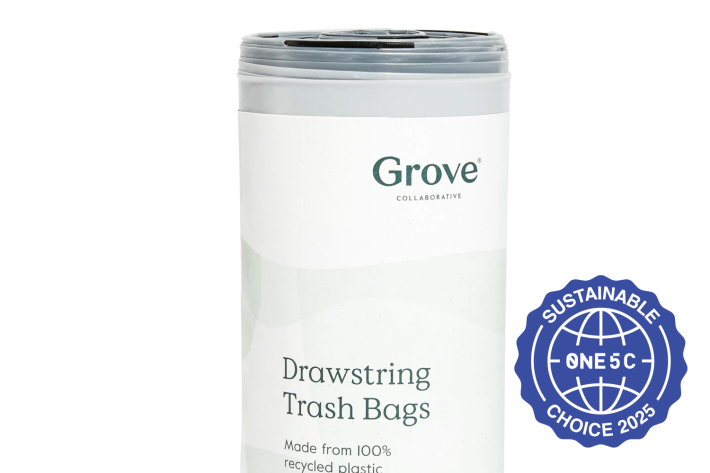
Well-constructed, tight-sealing, and impressively strong, Grove 100% Recycled Plastic Tall Trash Bags ($8 for 20; grove.co) are a planet-friendly upgrade that really succeeds. The bags performed well on all tests—trapping odors, preventing leaks, and holding 75 pounds of weight before tearing. Made from 100% post-consumer recycled materials, the sacks are a bit hard to tear from their roll. Still, that's a minor complaint considering both performance and that Grove is pretty buttoned up across the environmental board, including the fact that it runs all its owned and operated facilities on 100% renewable energy.
Runner-up: If You Care Recycled Trash Bags
If You Care Recycled Trash Bags ($7 for 12 bags; ifyoucare.com) would have taken the top spot if our assessment were based on performance alone. They withstood punctures, never leaked, trapped odors, and were incredibly strong. However, the bags didn’t do as well on our sustainability checkup: While the company’s packaging is buttoned up—they use 100% recycled materials—11% of the bags themselves comes from virgin plastic. That, plus a lack of transparency into the firm's energy and water use, knocked them down to second place.
What trash bags we tested
After researching the field, we settled on evaluating 13-gallon (aka tall kitchen) trash bags made from at least 89% post-consumer or post-industrial recycled content. We also made sure that all the bags are freely available for purchase online without requiring a subscription to a particular marketplace like Thrive. The bags ranged in price from $0.12 to $0.58 per bag and were:
- Green Polly 13-Gallon 100% Recycled Plastic Opaque Gray Blue Tall Kitchen Drawstring Trash Bags
- Grove Co. 13-Gallon 100% Recycled Tall Kitchen Easy-Tie Plastic Trash Bags
- If You Care 13-Gallon Recycled Trash Bags
- Typlastics 13-Gallon Tall Kitchen Drawstring Bags
- Who Gives A Crap 100% Recycled Tall Kitchen Trash Bags
How we picked the best recycled trash bags

Our product recommendations are based on two parallel assessment tracks: one for performance and one for sustainability. These ratings combine to land on our final winner, which represents the ideal blend of a product that’s good for the Earth and for your life. Read more about our assessment process here.
How we tested recycled trash bags
We spent a month testing these bags, putting them through their real-world paces: We unrolled, filled, tied, stretched, and sniffed them after a full night sweating on our kitchen floor. Our goal was to simulate everyday use in practical scenarios, which we reflected in following scored tests:
- Tensile strength test. We filled each bag with heavy household items—books, canned goods, dumbbells—then pulled it up off the floor, put it back down, and added more weight, repeating until the sack tore. We noted how much weight caused the bags to rip.
- Puncture test. To simulate sharp kitchen waste, we pushed a pencil point into the side of each bag and noted how easily it broke through.
- Leak test. We filled each bag with soaking wet towels to mimic juicy, wet trash and let them sit for 24 hours. Afterward, we checked for leaks and wet spots underneath.
- Odor control test. We sealed food scraps—including cut-up onions—inside each bag, left them in a hot car for 8 hours, and then took a big whiff. (Yes, we know this could’ve been composted.)
- Ease of use. We scored each bag on how easy it was to remove from its box or roll; open, insert, and retrieve from a standard 13-gallon bin; and tie them off and carry them to the back door.
How we scored sustainability
Our sustainability ratings take into account three factors: a product’s environmental impact at its production, what happens at its end-of-life, and the manufacturer’s environmental behavior. Production factors in where, how, and with what a product is made—as well as how it’s transported through the supply chain. For trash bags in particular, we looked at the percentage and type of recycled content and product durability relative to weight. We also assess end-of-life variables like toxicity and recyclability of the product and packaging, as well as actions the company takes outside the life of a product to minimize its footprint or benefit the environment. We award bonus points for transparency, as well. These scores are informed inferences based on available information, not full-blown life-cycle analyses.
How Grove’s 100% Recycled Trash Bags performed
Of all the bags we tested, the Grove Co. 100% Recycled Plastic Trash Bags ($8 for 20; grove.co) felt the most prepared for everyday life. While they were slightly less durable than the If You Care 13-Gallon Recycled Trash Bags ($7 for 12; ifyoucare.com), Grove delivered a strong, consistent performance across every category.
First things first: The 20 bags, made from 100% post-consumer recycled materials, come with minimal packaging (a paper sleeve) and tear off the tight roll with a quick—albeit strong—tug. They open without issue, have three easy-to-grab-and-tie flaps, and fit snugly into standard kitchen trash cans.
The three tie-off flaps look a bit odd, but they’re a standout feature. Their extra grip made these bags the easiest to extract from the can. For comparison, the Who Gives A Crap 100% Recycled Tall Kitchen Trash Bags ($18 for 40; us.whogivesacrap.org) performed well and stood up to heavy waste, but their built-in handles faltered a bit when the bags were full.
But the real question is whether or not these bags can handle your household trash. In short: They can. The bags didn’t leak when crammed full of sopping towels and were odor-free after holding warm kitchen scraps for a day. In our stress test, they held 75 pounds before tearing, which was especially impressive considering that the average heavy-duty kitchen bag can only hold between 35 and 40 pounds.
Most of the other bags had major trash-handling dealbreakers. The Typlastics 13-Gallon Tall Kitchen Drawstring Bags ($35 for 300; amazon.com) placed second-to-last in odor control, smelling of warm onions after our tests. They also punctured with even minimal force. The solid but thin Green Polly 13-Gallon 100% Recycled Plastic Tall Kitchen Drawstring Trash Bags ($60 for 240; greenpolly.com) performed similarly.
Nothing’s perfect: At $0.40 apiece, Grove’s trash bags were on the higher end of cost. Although you can opt for a monthly subscription to save 20% on your first order and 5% going forward. While a minor gripe, the bags did require a good stiff yank to separate from the perforated roll, which might be troublesome for those with hand strength or mobility challenges.
Why Grove’s 100% Recycled Trash Bags are sustainable
Although all trash bags have the same end-of-life (sitting in a landfill), those we tested vary greatly in terms of the sustainability of their production. Grove’s direct operations achieve carbon neutrality through 100% renewable electricity at their owned and operated facilities and the purchase of carbon offsets to balance out things like shipping—with a clear acknowledgement that offsets are far from perfect. But Grove doesn’t leave it there, as the company is working to further reduce emissions and advocates for policy that enables large-scale decarbonization.
Grove also scores highly for the materials they use in their trash bags: 100% post-consumer recycled plastic, which is more likely to wind up in a landfill than using pre-consumer plastic like production scraps. And, for each trash bag it sells, Grove also removes the same amount of plastic from the ocean. Since 2020, they’ve removed more than 17.6 million pounds of plastic.
The company is also a certified B Corp, and scores particularly high in environmental categories like air pollution and land conservation. For instance, Grove partners with The Nature Conservancy to support Indigenous-led conservation across two million acres of the Great Bear rainforest in British Columbia, which is Earth’s largest remaining coastal temperate rainforest.
Nothing’s perfect: Grove uses minimal paper packaging made with Forest Stewardship Council-certified materials, meaning that they adhere to strict guidelines around sustainable forestry. If we’re being nitpicky, we’d love to see this packaging made from recycled paper. Additionally, although they put money towards cleaning waterways, we’d like to see more from them in regard to reporting on and reducing their own water use.
The runner-up: If You Care 13-Gallon Recycled Trash Bags
If our tests considered performance alone, If You Care 13-Gallon Recycled Trash Bags ($7 for 12; ifyoucare.com) would've earned the top spot. It held nearly 90 pounds of trash before ripping, was tough to pierce, never leaked, and was the best at keeping nasty odors at bay.
But our two-pronged methodology sunk If You Care from the top spot, as it struggled on the sustainability front. The company isn’t very transparent about its emissions, and the bag itself is made from 11% virgin plastic.
Matt Schneiderman is a freelance writer and editor based in San Francisco. His work has appeared in Popular Science, Runner’s World, Healthline, Fatherly, and more.
Tyler Santora is a freelance science journalist, editor, and fact-checker. He’s written for publications such as Undark, Scientific American, Popular Science, and more.
one5c does not earn a commission on any product purchased through our reviews.