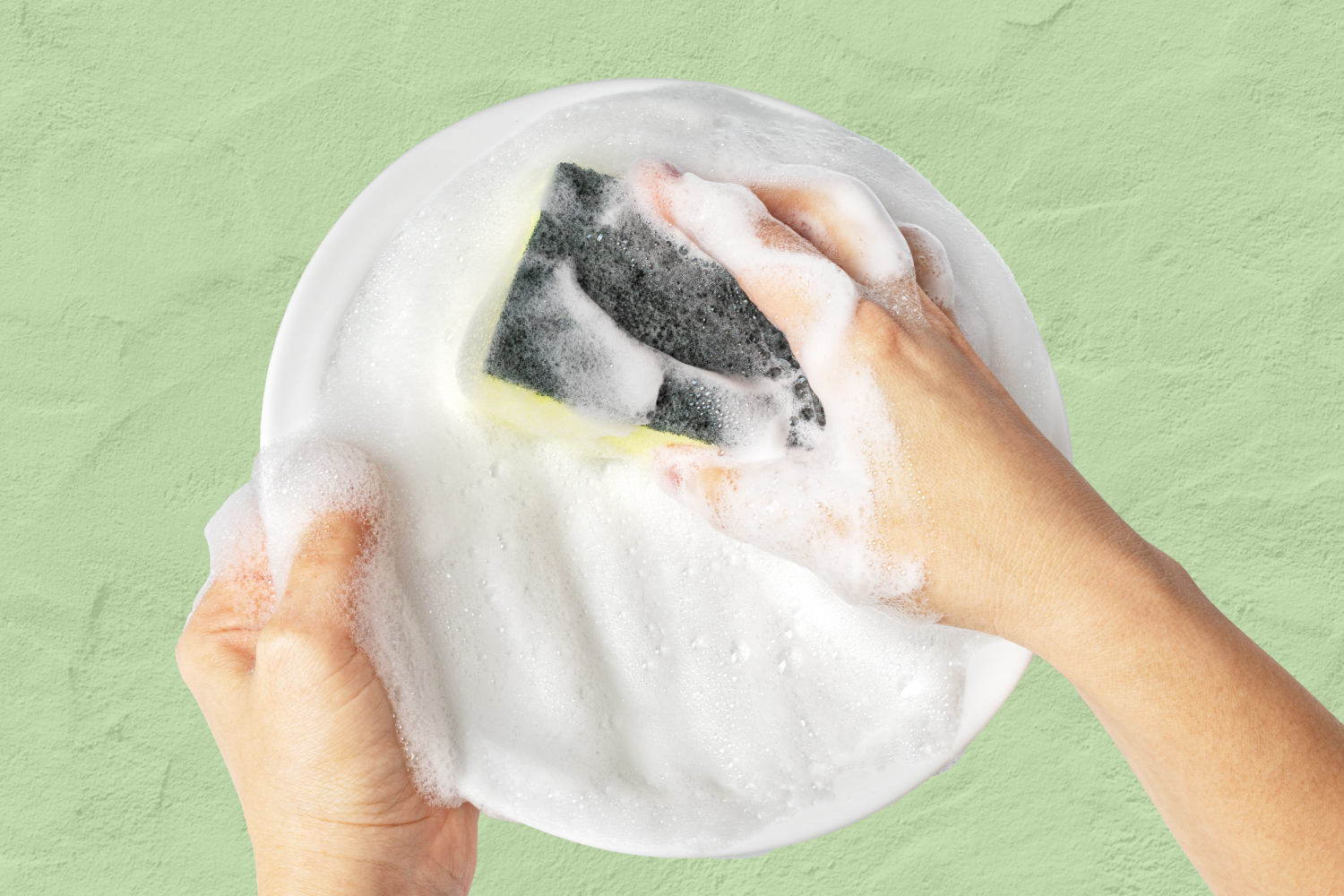


The paper towel is the go-to cleaning companion in most American households. We grab for a sheet (or three) any time there’s a spill to absorb, countertop to clean, window to wipe, or other ewww to handle. In 2017 alone, Americans spent more money on paper towels than all other countries in the world—combined. But most paper towels are made from virgin wood pulp, which means we’re felling forests for a single-use product that typically can’t be recycled.
There are plenty of less wasteful ways to wipe, from rags and cloth napkins to mops and Swedish dishcloths. But if nothing can tear you away from ripping sheets off a roll, making the switch to recycled paper towels a more Earth-minded choice. Made from a mix of post-consumer recycled content—such as office paper, newspaper, and packaging scraps—and manufacturing waste—recycled paper towels have a lower environmental cost than their virgin counterparts. This is due to a lot of factors, but the biggie? Because they don’t contribute to deforestation.
Now, recycled paper towels can be hit or miss. Chances are you’ve had a bad experience with a roll of recycled paper towels—or four. Who among us hasn’t grabbed a sheet only to watch it disintegrate as soon as it touches a few droplets? Or needed a stack to clean a mess that a couple conventional sheets would have contained?
That’s why we spent a month wiping up countertops and cleaning up spills with five popular recycled paper towel brands. We ran each through a series of real-life cleaning trials and put their absorbency and durability to the test. Even though any one of these wipers is better than one made from fresh trees, we also evaluated the Earth-friendliness of our contenders. The towels that rose to the top delivered a rare combo: strong on cleanup, light on planetary guilt, and just absorbent enough to make you forget you’re wiping with old packaging.
one5c’s pick: Seventh Generation Unbleached Recycled Paper Towels
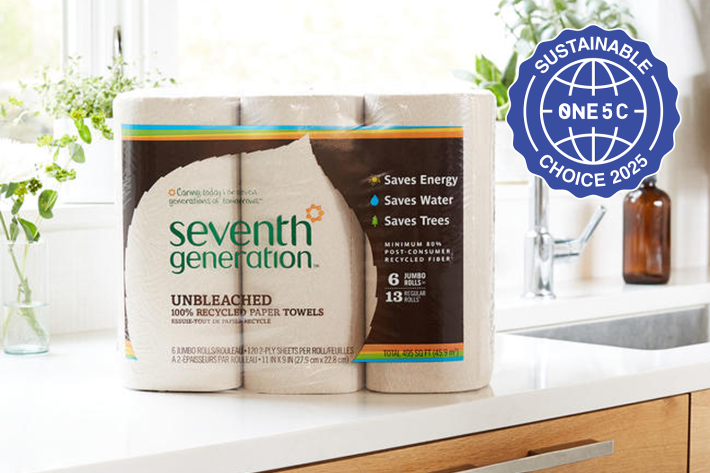
Soaking up more than twice their weight and wiping effectively, Seventh Generation’s Unbleached Recycled Paper Towels ($17 for 6 rolls; seventhgeneration.com) are capable of tackling a variety of cleaning tasks. Like the house tabby cat, recycled paper towels are known to start shedding as soon as they do any work, but these stayed intact through every task we threw at them. The sheets are made with 80% post-consumer recycled materials, have no bleach, and come from a factory powered party by renewable sources.
Runner-up: 365 by Whole Foods Market, 100% Recycled Jumbo Paper Towels
The 365 by Whole Foods Market, 100% Recycled Jumbo Paper Towels ($4.19 for 3 jumbo rolls; wholefoodsmarket.com) are the most conventional-feeling paper towels of the bunch. Their texture is closer to standard rolls, and the thick, patterned sheets could fool you into thinking they’re something other than recycled. While they aced our performance tests—absorbing the most water, enduring the most weight, and handling everyday tasks with ease—and are made with up to 80% post-consumer paper, the brand’s relationship to Whole Foods (and therefore Amazon) ultimately nudged them out of the top spot.
What recycled paper towels we tested
We selected a range of 100% recycled paper towels that were well-reviewed, widely available, and that scored well on the NRDC’s “The Issue with Tissue” report, which grades the sustainability of toilet paper and paper towels. The rolls we tested were:
- 365 by Whole Foods Market, 100% Recycled Jumbo Paper Towels
- Everspring by Target 100% Recycled Paper Towels
- Seventh Generation Unbleached Recycled Paper Towels
- Trader Joe’s Recycled Paper Towels
- Who Gives A Crap 100% Recycled Paper Towels
How we picked the best recycled paper towels

Our product recommendations are based on two parallel assessment tracks: one for performance and one for sustainability. These ratings combine to land on our final winner, which represents the ideal blend of a product that’s good for the Earth and for your life. Read more about our assessment process here.
How we tested recycled paper towels
We used all five paper towels over the course of a month, assessing their performance in everyday use. One major factor we looked out for: Clean tear-ability. It matters, because if you end up unraveling a ribbon of sheets when you only needed one, that leads to waste. As we sopped up spills and wiped windows, we also performed the following graded tests:
- Absorbency test: We weighed a dry sheet of paper towel on a kitchen scale. Then we poured 50 milliliters of water into a dish and dipped the sheet into it for 10 seconds. After letting it drip-dry for 10 seconds, we weighed it again, subtracting the dry weight from the wet weight to calculate how much water it absorbed.
- Strength test: We took a soaked sheet of paper towel, hung it hammock-style between two 10-inch-tall stacks of cookbooks, and began adding pennies to the center. We recorded how much weight each wet towel could hold before tearing.
- Durability test: We dampened a sheet and scrubbed dried honey off a composite countertop—back and forth 12 times. We then assessed how torn or intact the sheet was after scrubbing, to measure real-world resilience.
How we scored sustainability
Our sustainability ratings take into account three factors: a product’s environmental impact at its production, what happens at its end-of-life, and the manufacturer’s environmental behavior. Production factors in where, how, and with what raw materials a product is made—as well as how it’s transported through the supply chain. End-of-life considers any potential toxicity, like, in the case of paper products, any formaldehyde. The final factor involves actions the company takes outside the life of a product to minimize its footprint or benefit the environment, and we award bonus points for transparency, as well. These scores are informed inferences based on available information, not full-blown life-cycle analyses.
How Seventh Generation Recycled Paper Towels performed
Recycled paper towels have a bit of a PR problem. It’s easy to write them off as as flimsy knockoffs of their famous quilted cousins. And, let’s be honest, some of that reputation is well-deserved. But Seventh Generation Unbleached Recycled Paper Towels ($17 for 6 rolls; seventhgeneration.com) help redeem the category. They scored well on all tests, absorbing more than twice their weight in water, suffering only a few tears when scrubbing the honey, and holding the weight of about 40 pennies before tearing. But where they really shined was in everyday use: Whether cleaning the inside of a microwave or soaking up spilled protein shakes, they were more than capable.
If a paper towel can’t perform its wiping, absorbing tasks without tearing or turning into a wet pile, then it’s not worth its spot on the holder. While we were skeptical of the towels at first, Seventh Generation's wipers succeeded and surprised us with how sturdy and practical they were—even during tougher scrubbing tasks that tore its competitors apart.
Based on the strength of their toilet paper’s performance, we had high hopes for Who Gives A Crap Recycled Paper Towels ($22 for 6 rolls; whogivesacrap.com). Unfortunately, the thin sheets were a bit flimsy, shedding slightly during the scrub test and struggling during daily use. Trader Joe’s Slim Size Paper Towels ($4 per roll; traderjoes.com) and Everspring by Target 100% Recycled Paper Towels ($15 for 8 rolls; target.com) both turned kinda sludgy when dampened with all-purpose cleaner and put to work on a dried glob of honey.
While Seventh Generation didn’t best the 365 by Whole Foods Market, 100% Recycled Jumbo Paper Towels ($4.19 for 3 rolls; wholefoodsmarket.com) (more on them below), they earned our respect by being just-fine towels that get the job done without making us grab seven of them to tackle a spill.
Nothing’s perfect: Seventh Generation's towels ranked second in performance behind 365 by Whole Foods, which beat out the entire pack in durability, strength, and absorbency. And, at $17 for six rolls, they might be a tough sell for some, especially when big names like Bounty sell six triple-sized rolls for the same price. Purists might struggle with them, too, as they don’t feel quite like traditional paper towels.
Why Seventh Generation Recycled Paper Towels are sustainable
As far as paper towels go, there’s not a lot that could make Seventh Generation’s any gentler on the planet—except if they didn’t exist at all. The 100% recycled towels are made from 80% post-consumer materials, which is tied for the highest of any offering we looked at. Repurposeing stuff like old newspapers and office paper is preferable to using manufacturing scrap, because it rescues refuse that might otherwise wind up in the landfill. The wipers are also unbleached (duh) and free for any formaldehyde or other potentially harmful chemicals.
Though Seventh Generation is part of Unilever, they still are pushing their own environmental agenda. The firm set a Science-based Climate Target to cut emissions from its facilities and energy (aka Scopes 1 and 2) entirely and those from its supply chain (aka Scope 3) by 80% by 2030, and the company publishes annual updates on progress towards those goals. Crucially, Seventh Generation has made strides in Scope 3 emissions—the hardest to address by far. They, for example, created a Green Power Program to help third-party manufacturers tap more renewable energy.
Nothing’s perfect: While there is movement across the board in terms of hitting its climate goals, Seventh Generation does have a couple planetary hiccups worth mentioning. Since it set its emissions-reduction targets, it’s had to pull back on its Scope 3 ambitions and is now aiming for a 25% cut by 2030. There’s also a bit of an asterisk on the way it flexes achieving its Scope 1 and Scope 2 wins: While they count their goals as complete, they credit the dip in emissions to adopting renewable energy and, uh, natural gas—which, while better than oil or coal, is still a fossil fuel.
Seventh Generation is also part of Unilever. They do take their role as an environmental lighthouse for the consumer-product giant seriously—for example calling their parent company out for the ways their banking and investments fund fossil-fuel expansion—but the association still stings a bit. Unilever consistently ranks among the world’s top plastics polluters.
The runner-up: 365 by Whole Foods Market, 100% Recycled Jumbo Paper Towels
If our winner was determined by performance alone, the 365 by Whole Foods Market, 100% Recycled Jumbo Paper Towels ($4.19 for 3 jumbo rolls; wholefoodsmarket.com) would’ve taken the dub. They’re strong and absorbent, able to hold more than three times their weight in water and endure a load of 53 pennies, and were the closest in feel and function to standard paper towels. In fact, they handled every task we threw their way so well we checked our receipt: we thought we’d purchased the wrong samples.
If we scored sustainability based on the towels alone, these would have run the table. They’re made in the U.S. from up to 80% post-consumer material—a shade less than Seventh Generation—and use a non-chlorine bleaching process. But 365 is a Whole Foods brand, and Whole Foods is owned by Amazon. That makes them a no-go for anyone who chooses not to support companies that aren’t on the straight-and-narrow in terms of environmental stewardship.
Aside from the overconsumption the ecommerce giant helped perpetuate, their planet-warming potential is headed in the wrong direction. Amazon’s Scope 3 emissions—the chunk that comes from its sprawling supply chain—makes up about three-quarters of its total and increased by 6% in 2024. And that’s alongside a 6% jump in the footprint of its own facilities and a 1% rise in the energy used to run them.
Matt Berical is Senior Editor at one5c and a longtime writer and editor based in Richmond, Virginia. Most recently, he was the deputy editor of the parenting site Fatherly for seven years. His work has appeared in GQ, Men’s Journal, Taste, Popular Science, and more.
Corinne Iozzio is the Editor-in-Chief of one5c, and an award-winning science and tech editor with more than 15 years of experience.
one5c does not earn a commission on any product purchased through our reviews.
Correction (11/20/25): This article has been updated to fix a typographical error in our scoring visualization. Who Gives A Crap received a 90% score for its corporate transparency and sustainability, not a 50% mark as previously shown.