

If your stash of plastic food containers is a graveyard of warped lids, lingering odors, and mystery stains, it might be time to upgrade to glass. Glass food storage containers heat evenly, withstand the microwave, cool safely, and withstand years of regular use without cracking, yellowing, or leaving you with a lingering reminder of last month’s pasta sauce.
A good glass food container set is a kitchen workhorse—great for leftovers, meal prep, or lunch. Most sets nest or stack neatly, and though their lids are typically plastic, that’s by design: The flexible material allows for tighter seals and better leak protection. It also cuts down on weight.
We spent weeks researching and testing top-rated glass storage containers to find an option worthy of your kitchen. We evaluated each one for leak and stain resistance, microwave friendliness, and durability—and also investigated what the companies who make them do to safeguard the environment. Our winning glass storage container is practical, reliable, and will keep your food fresh and your fridge organized. It also comes from a company trying to do right by the planet.
one5c’s pick: Ikea 365+ Food Storage Container
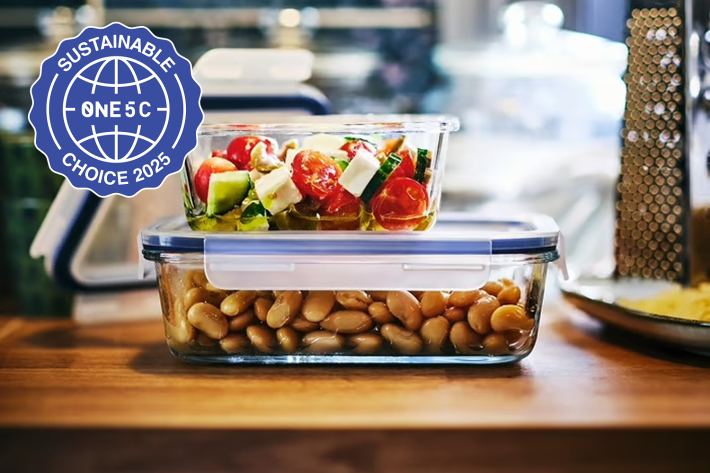
A reliable vessel that sealed tight, opened smoothly, and cleaned up easily after serious abuse, the Ikea 365+ Food Storage Container (from $5; ikea.com) balances everyday usability with long-term durability. Its lid’s strong seal prevented any leaks and didn’t loosen even after 100 open-close cycles. The vessels are also easy to stack and simple to open. Ikea’s also minding its footprint: The company runs its factories on 100% renewable energy, aims to halve emissions by 2030 and reach net-zero by 2050, and is incredibly transparent about its goals and progress.
Runner-up: Pyrex Freshlock Glass Food Storage Container
The Pyrex Freshlock Glass Food Storage Container (from $10; pyrexhome.com) was our top performer, but couldn’t seal the deal on sustainability. The vessel stayed leakproof, opened smoothly, and emerged spotless from our stain tests. Its snap-lock lid felt sturdy and reliable and kept odors from seeping out. While the container comes in plastic-free packaging, and we love that you can replace just the lids, Pyrex wasn’t transparent enough about its climate goals and initiatives to shine in terms of planet-friendliness.
What glass food containers we tested
We looked for glass food storage containers that come from widely available brands and have strong customer and professional reviews. All models we selected featured glass bases and snap-lock plastic lids. We tested roughly the "medium" size of each lineup—generally ranging from 32 to 48 ounces—volumes that allowed us to store a wide range of foods. Prices varied from $6 to $20 depending on the retailer. The containers we tested:
- Ello Duraglass Food Storage Container
- Glasslock Oven Safe Glass Food Storage Container
- Ikea 365+ Food Storage Container
- OXO Smart Seal Glass Container
- Pyrex Freshlock Glass Food Storage Container
- Rubbermaid Brilliance Glass Storage Container
How we picked the best glass food container

Our product recommendations are based on two parallel assessment tracks: one for performance and one for sustainability. These ratings combine to land on our final winner, which represents the ideal blend of a product that’s good for the Earth and for your life. Read more about our assessment process here.
How we tested glass food storage containers
We used each container with real leftovers over the course of a month—storing everything from salad to leftover chicken—to see how they handled the wear and tear of daily use. In addition, we conducted the following graded tests to evaluate performance under more-controlled conditions:
- Leak test: We filled each container with 250 milliliters of water, shook it vigorously in multiple directions, then left it upside-down for 30 minutes. We inspected for leaks of any kind.
- Microwave heat test: We microwaved 2 cups of water in each container for 2 minutes and 45 seconds—long enough to simulate a typical reheat and push the material’s heat resistance—then measured the temperature of the water as well as the external surface temperature. A cooler exterior meant a lower risk of burning your hands.
- Lid durability test: We opened and closed each lid 100 times to assess wear. We looked for signs of looseness, cracking, and general flimsiness in the lids after this stress test.
- Stain & odor test: To simulate accidentally leaving one of these containers in your car over a weekend, we filled each one with veggie tikka masala—amped up with extra garlic powder, turmeric, and olive oil—and left them on their sides in a hot garage for 48 hours. After a dishwasher cycle, we inspected each container for lingering stains or smells.
How we scored sustainability
Our sustainability ratings take into account three factors: a product’s environmental impact at its production, what happens at its end-of-life, and the manufacturer’s environmental behavior. Production factors in where, how, and with what a product is made—as well as how it’s transported through the supply chain. End-of-life takes into account the toxicity of the materials used, the product’s warranty, whether the company sells spare parts, and how brands help buyers recycle old products. The final factor involves actions the company takes outside the life of a product to minimize its footprint or benefit the environment, and we award bonus points for transparency, as well. These scores are informed inferences based on available information, not full-blown life-cycle analyses.
How the Ikea 365+ glass food container performed
Glass containers with snap-locking lids might seem very similar when you're browsing them online. After all, they're all just round or square tubs with latching plastic lids and some kind of sealing gaskets. But once in hand, the differences are significant. And when we started filling, shaking, and microwaving them, the field separated a lot.
The Ikea 365+ Food Storage Container (from $5; ikea.com) comes in a variety of sizes for you to piece together a collection that suits you. We tested a 34-ounce rectangular version. Right away, we noticed how easy it was to seal and unseal: The plastic lid has deep, substantial tabs that provide lots of leverage when popping it open and secure it closed with a satisfying click. This is unlike what we experienced with the Glasslock container (from $14; glasslockusa.com), which shut securely but was difficult to open.
The Ikea container stood up well to all our abuse. During the leak test, it was bone dry after 30 minutes upside-down, matching the performance of most of the vessels we tested. (We were disappointed that the OXO Smart Seal (from $9; oxo.com) leaked.) The snap-lock mechanism held up through 100 opening cycles, unlike the Glasslock and Rubbermaid Brilliance (from $20; rubbermaid.com), both of which started to feel loose or sticky.
As far as stain resistance, the Ikea container cleaned up well after three dishwasher cycles, with one small caveat: The striated silicone gasket on the lid, which is what forms the container’s super-tight seal, did retain some turmeric residue in its tiny grooves. We had a similar issue with OXO’s Smart Seal, but Ikea’s gasket does pop off for cleaning—a nice touch. The Pyrex Freshlock, by comparison, emerged completely spotless.
Overall, Ikea makes a great food storage container. But the real standout feature might be its repairability: New lids cost just $2 each, so when your gasket eventually wears out, you don't need to replace the whole setup.
Nothing's perfect: The container gets hot fast in the microwave. Its interior hit 160.7 degrees F, while the exterior reached 132.4 degrees F, only a 28-degree difference that could lead to some burned fingertips. Compare that to the OXO (a 51-degree difference) or Pyrex Simply Store (also 51 degrees), and you're dealing with much more heat transfer. Not a deal breaker but something good to keep in mind. Another one: When the container is hot, its rim doesn’t offer that much area to grip, which makes it hard to move. This is especially notable compared to the wider handles of the Rubbermaid—though that container clung to odors and has a lid that was a pain to attach.
Why the Ikea 365+ glass food container is sustainable
While there’s not much to tease apart in terms of the materials each container is made of (tempered or borosilicate glass with BPA-free plastic lids), we can’t say the same about differences in each company’s approach to their energy and water use. In that respect, Ikea is a standout.
The company operates its own factories and packaging and distribution centers on 100% renewable electricity, and they’ve helped 44% of their direct suppliers switch to running on% renewables too. Renewable energy powers 71% of all other company operations, including retail. In terms of emissions, Ikea has a goal to slash them in half by 2030 and reach net-zero by 2050—without the use of carbon offsets. So far, they have cut down by 28%.
In 2024, the company set its first goals for reducing water use, with a special focus on river basins in areas with high levels of water stress. They also support several non-profits and research organizations that are tackling water issues. For one, Ikea has partnered with the Research Institute of Sweden on a two-year field study analyzing how initiatives like low-flow taps and shower monitors affect water use.
Lastly, Ikea places a lot of stake in being transparent about its ethics. The company has initiatives to support refugees, gender equality, and LGBT+ inclusion, such as by joining the Equal Pay International Coalition. And The Ikea Foundation works with more than 150 partners on issues related to poverty and climate change.
Nothing’s perfect: Though about 17% of the materials Ikea sources are recycled, there’s no information about whether or not that sum includes its glass storage containers. We also wish the company provided details on recycling the containers, particularly the lids, as it’s unclear if they can go in the regular curbside blue bin. We’d also love it if the company had a take-back program in place.
The runner up
The Pyrex Freshlock (from $10; pyrexhome.com) is also a strong performer. It matched the Ikea container in the leak test (zero seepage) and edged it out in the stain and odor trial. It came out completely clean and neutral-smelling after repeated washes, likely thanks to its simpler gasket design, which has fewer crevices that could trap food residue. Its lid seals securely and opens and closes with a confidence-inspiring snap.
In most sustainability categories, Pyrex was neck-and-neck with Ikea. Its packaging is efficient and plastic-free, the container is durable, and its lids are replaceable. However, Pyrex’s parent company provides no information on its progress in meeting its goal of reducing water and energy use by 30% and 20%, respectively, by the end of this year—or, given that percentages are relative, what numbers they were starting to begin with.
Jesse Will is a writer based in Austin, Texas. His work has appeared in Men’s Journal, The New Yorker, Rolling Stone, The Wall Street Journal, Pitchfork, Popular Science and Road & Track.
Tyler Santora is a freelance science journalist, editor, and fact-checker. He’s written for publications such as Undark, Scientific American, Popular Science, and more.
one5c does not earn a commission on any product purchased through our reviews.