


Americans send more than 133 billion pounds of food to waste each year. That’s about one-third of the entire supply ending up in landfills, where it decomposes anaerobically, producing the potent greenhouse gas methane. Composting is one of the simplest ways to break this cycle—and it often starts with a good compost bin in your kitchen.
Composting is the process of breaking down organic matter into nutrient-rich material called humus, which can happen either at home or at a municipal facility. The process starts with collecting food scraps, which means you’ll need a good compost bin if you don’t want your kitchen to be a breeding ground for pests or face-scrunching odors. Placed on your countertop or under your sink, it’ll happily collect coffee grounds, eggshells, and veggie scraps until it’s full enough to empty into your outdoor compost pile or your local green waste bin.
A crummy compost bin can be enough to make you give up on the entire enterprise: They can leak, smell, attract pests, and be grossly hard to clean. A good kitchen compost bin has none of these flaws and can be attractive enough to not be relegated to a dark corner. In other words, it should do everything your regular trash can does—but better.
So what compost bin deserves a place in your kitchen? We spent several weeks researching and testing five top-rated models. We evaluated everything from odor control and ease of use to the planet-friendliness of the bins themselves, and landed on a smartly-designed compost bin that comes from a company trying not to trash the planet.
one5c’s pick: Bamboozle Astrik
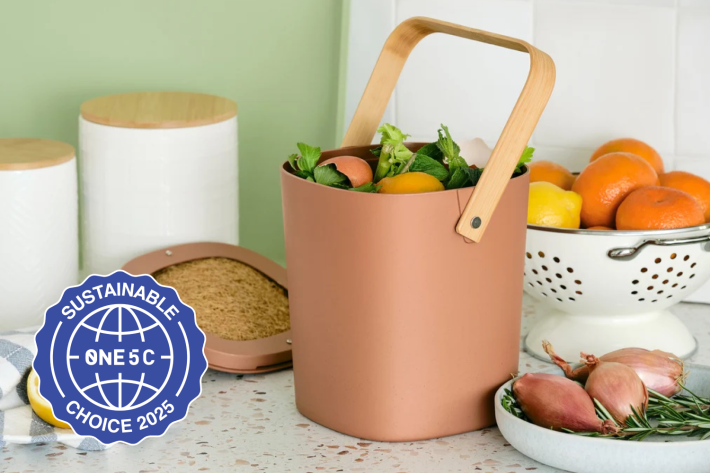
The Bamboozle Astrik ($50; bamboozlehome.com) earned the highest performance score of the group for one simple reason: It nailed the fundamentals. The 1.85-gallon compost bin is easy to clean, traps the funky smells of rotting scraps, remains comfortable to hold even at full capacity, and is sleek enough to sit proudly on your countertop. Our favorite feature? Its lid, which is well-ventilated and has a slot to insert plant-based filters. Sustainability-wise, the Astrik scored good marks for its minimal packaging and the fact that its body is made partly from bamboo fibers, some of which it sources as scrap from furniture factories.
The runner-up: OXO Good Grips Easy-Clean Compost Bin
The OXO Good Grips Easy-Clean Compost Bin ($23; oxo.com) lives up to its name thanks to a thoughtful, no-frills design. Its seamless interior makes cleaning simple—there are no odd angles or crevices for coffee grounds or food scraps to fall into—and its slightly flared body helps grip liner bags securely (should you choose to use them). The 0.75-gallon bin has a lightweight, hinged lid that’s easy to flip open and closed and traps odors well. While it doesn’t offer the higher-end touches of the Astrik, it’s an excellent budget-friendly, entry-level container.
What compost bins we tested
When selecting which kitchen compost bins to test, we focused on products that have good reviews from credible brands, are readily available online, and have capacities of two gallons or less to ensure they’d fit easily on a countertop or under the sink. Finally, we capped our price range at $50. We settled on:
- Bamoozle Astrik Compost Bin
- Epica 1.3 gallon Compost Bin
- Lomi 4-liter Food Waste Storage Bin
- OXO Good Grips 0.75-gallon Easy-Clean Compost Bin
- Simplehuman One Gallon Compost Caddy
How we picked the best compost bin
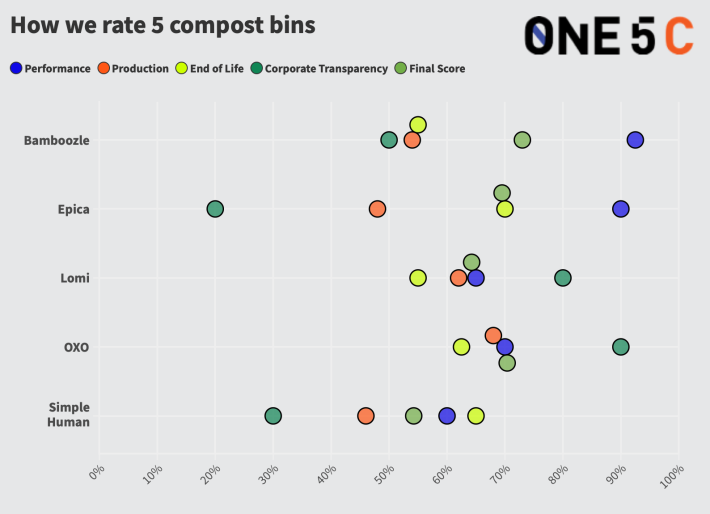
Our product recommendations are based on two parallel assessment tracks: one for performance and one for sustainability. These ratings combine to land on our final winner, which represents the ideal blend of a product that’s good for the Earth and for your life. Read more about our assessment process here.
How we tested compost bins
Over the course of several weeks, we tested the compost bins on four main components: ease of use, ease of cleaning, smell containment, and security of the lid.
- Ease of use test: This multifaceted assessment involved testing how easily each bin can be opened, filled, closed, carried, and emptied. We filled each bin with five pounds of sand mixed with vegetable scraps to simulate real-world usage and evaluated the comfort of handles, as well as the design and functionality of lids and liners.
- Ease of cleaning test: We hand-washed each model and made note of any pain points. This included disassembling the bins where possible and checking to see if there were any narrow seams or crevices where food scraps might get trapped.
- Odor test: To evaluate odor control, we placed a tablespoon of rubbing alcohol—a potent VOC—in each bin and assessed odor leakage at two distances: directly above the lid and three feet away.
- Lid security/pest resistance test: To evaluate how well each bin kept pests out, we placed food scraps inside and monitored for insects over a few weeks—especially fruit flies. We also tested how secure the lids were and how resistant the bins were to tipping: After placing the lid atop the bins, we’d try to flick the lids open using the strength of what we’d imagine a cat would have.
How we scored sustainability
Our sustainability ratings take into account three factors: a product’s environmental impact at its production, what happens at its end-of-life, and the manufacturer’s environmental behavior. Production factors in where, how, and with what a product is made—as well as how it’s transported through the supply chain. End-of-life takes into account the toxicity of the materials used, the product’s warranty, whether the company sells spare parts, and how brands help buyers recycle old products. The final factor involves actions the company takes outside the life of a product to minimize its footprint or benefit the environment, and we award bonus points for transparency, as well. These scores are informed inferences based on available information, not full-blown life-cycle analyses.
How the Bamboozle Astrik performed
The Bamboozle Astrik ($50; bamboozlehome.com) is a design-forward bin that nails the big and small details. Made from primarily plant-based materials like bamboo, the compost bin is available in five matte-finished colors, including forest green, graphite, and tan. It has a large, wooden carrying handle and a nicely ventilated lid with a knob-style handle. At $50, the Astrik is one of the more expensive compost bins we tested. But in our opinion, it’s worth it.
The Astrik does a great job of not just trapping, but eliminating odor—we never noticed anything unpleasant emanating from the bin. This is thanks to a smart combination of vents in the lid that encourage airflow (important to help scraps break down) and a slot on the underside that holds the brand’s hemp-based filters. (The filters are sold-separately; a pack of six will run you $15 and should last about a year.)
Other bins struggled to contain odors as effectively. The silo-shaped Epica 1.3-gallon Compost Bin ($29; amazon.com) has a great, tight-fitting circular lid that also featured a filter—theirs is active charcoal—but lacks any real ventilation. This caused a strong, built-up puff of odor to release whenever the container was opened. The OXO Easy-Clean Compost Bin ($23; oxo.com), which performed quite well on all tests, was mostly odor-free, save for some slight seepage, but its lid isn’t very secure. The Lomi 4-liter Food Waste Storage Bin ($40; lomi.com) is well designed, but closing the lid requires you to align eight slots. When aligned, the seal is secure; when it isn’t, it creates a gap for bugs.
Because a compost bin needs to be carried frequently, sturdiness is a big selling point. When we filled the Astrik with five pounds of sand during testing, its bamboo handle, though slightly uncomfortable to grip for extended periods, felt secure and showed no signs of stress. Other handles weren’t as accessible. The handle on the stainless steel Simplehuman 1-Gallon Compost Caddy ($50; simplehuman.com), for instance, is only accessible from the back. When it was time to bring the bin to a pile, our natural inclination was to lift it from the top instead, which was unsteady.
The Astrik also stood out in how easy it is to clean. Its six-inch-wide base offers plenty of room for a hand and a sponge, and has no crevices or crannies for food to get trapped. This wasn’t the case for bins like the Lomi and the Simplehuman. The Lomi features a clever internal strainer to separate liquids from solids, and Simplehuman has a removable inner plastic liner; we liked both, but they made the interiors feel a bit cramped and also created too many places for detritus to collect and get stuck.
Aside from the screws that secure the handle, the Astrik’s interior is smooth and simple to wash. As an added bonus, the entire bin is dishwasher safe.
Nothing’s Perfect: At $50, Astrik is expensive—and using it to its best advantage can make it more-so. The bin lacks a lip or rim, which, if you choose to use compost bags, can make it difficult to secure them in place compared to other models we tested. The Epica, for example, features a metal lip around the opening that’s good for grabbin’ bags. Bamboozle does sell a reusable silicone liner in lieu of bags for $20, or you can get one in a bundle featuring the bin, liner, and a set of its hemp-based filters, which would bring the total to $85. We also found the lid’s square-knobbed handle a bit difficult to grab and lift.
Why the Bamboozle Astrik is sustainable
Let’s get this out of the way: None of the compost bins we looked at aced our sustainability tests. That doesn’t mean they’re bad for the Earth, though—because they all work to enable the planet-saving behavior of keeping food waste out of the landfill. In terms of other metrics of planet-friendliness, the Astrik sits squarely in the middle of the pack.
The material is the main flex here. Bamboozle’s signature plastic—the titular Astrik—is made from a combination of PLA (a thermoplastic typically derived from corn starch or sugarcane) and bamboo fibers. Bamboo can be a greenwashy enterprise, but Bamboozle says a portion of the would-be panda food it uses comes from scraps at furniture factories. Its materials also come from Forest Stewardship Council-certified cultivators, meaning growth is managed responsibly. The final product is also free from any chemicals and additives and safe for factory workers to be around.
The other bins we looked at are made of either stainless steel or polypropylene plastic, or both—materials that are more energy intensive to produce than Bamboozle’s bio-based plastic. Worse: The Simplehuman bin is the only one of the other quartet of contenders to use any recycled materials; its plastic liner is made from post-consumer polypropylene.
Bamboozle’s packaging is also pretty minimal, which we appreciate. The bin came wrapped in craft paper and a cardboard box, with only a little tape on the handle.
Nothing’s perfect: The Astrik material is both a blessing and a curse. By Bamboozle’s own estimates, the bin will last anywhere from 2 to 5 years, meaning that unlike a vessel made from stainless steel or a durable plastic like polypropylene, this is not a lifetime purchase. It’ll break down quickly in a landfill—because plants—or you can take it to an industrial composting facility. It would be great if Bamboozle helped folks ensure a better end-of-life. Also so-so news on the waste front: Bamboozle recommends that you use its housemade filters to manage any food funk. We don’t love the need for any extra purchases, but at least they’re made from hemp, which is a fast-growing plant that breaks down easily in home compost heaps.
We’d also love to see Bamboozle be more forthcoming about the planetary impacts of its operations. They don’t publish a sustainability report or any information on their emissions or water use—speaking mostly in generalities about their eco bona fides in things like blog posts. They say that they have research and reports to back up their claims around biodegradability, but didn’t respond to our requests for more details.
The runner up
The 0.75-gallon OXO Good Grips Easy-Clean Compost Bin ($23; oxo.com) delivered solid performance and sustainability scores and is half the price of the Astrik, making it an easy-to-maintain bin with a straightforward design that offers a lot for its value. OXO wasn’t kidding about this bin’s name. The interior is smooth and seamless, which makes it easy to wipe down with a sponge or cloth. This ease of cleaning is even more noticeable if you plan on using bin liners, as the bucket features a slightly flared lip that keeps them from slipping—a small, thoughtful touch.
The bin features a comfortable handle that makes carrying easy. However, we did find the hinged lid to be a little too light; it’d be pretty easy for a cat or a young child to flip it open and get at the contents. The bin trapped odors pretty well, but we did notice some seepage during the smell test—though only when we were right next to it.
If our winner was chosen based on sustainability alone, OXO would have run away with the top spot. Though it’s made from virgin plastic, polypropylene is durable—meaning with proper care this bin can last a lifetime. The bin’s packaging is delightfully minimal: literally just a sticker holding the lid closed. OXO also sells replacement lids. OXO’s parent company, Helen of Troy, publishes an annual sustainability report detailing its emissions and water use, and OXO itself is part of the Climate Action Corps, a group of brands committed to drawing down their greenhouse gas emissions.
Jon Chan is a man who loves testing products, writing informative articles, and filming funny videos. He has been making stuff for the Internet since 2012. His work has been published in USA Today, AOL, and more.
Corinne Iozzio is the Editor-in-Chief of one5c, and an award-winning science and tech editor with more than 15 years of experience.
one5c does not earn a commission on any product purchased through our reviews.