

Non-stick pans were a game-changer for home cooks, their polymer-based coatings allowing everything from creamy beans to fried eggs to slide out with little mess and little-if-any oil. But many of those coatings include forever chemicals like PFAS and PTFE, which can linger in the environment for decades and may release harmful fumes if overheated. Minnesota has already banned the sale of cookware with intentionally added PFAS, while other states are preparing similar measures.
To be fair, traditional nonstick pans are generally safe when used correctly—heating within recommended temperature limits, avoiding metal utensils, and replacing them once the coating scratches or begins to wear—but ceramic-coated cookware comes with none of those caveats. Made from plentiful natural materials like silica sprayed on top of aluminum cores, ceramic-clad pans don’t emit toxic fumes, heat quickly, cool efficiently, and perform well at high temperatures.
Still, none of this matters if the pans flop at flipping pancakes. That’s why we spent several weeks in a professional kitchen testing five top-rated ceramic skillets to see which is worthy of a place on your pot rack. We pushed each one to its limits—scrambling eggs, flipping pancakes, and scratching each skillet with metal utensils—before evaluating the sustainability efforts of the brands that make them. Our winning skillet is lightweight, easy to maneuver, incredibly non-stick, and comes from a company trying its best not to stick it to Mother Earth.
one5c’s pick: GreenPan Valencia Pro
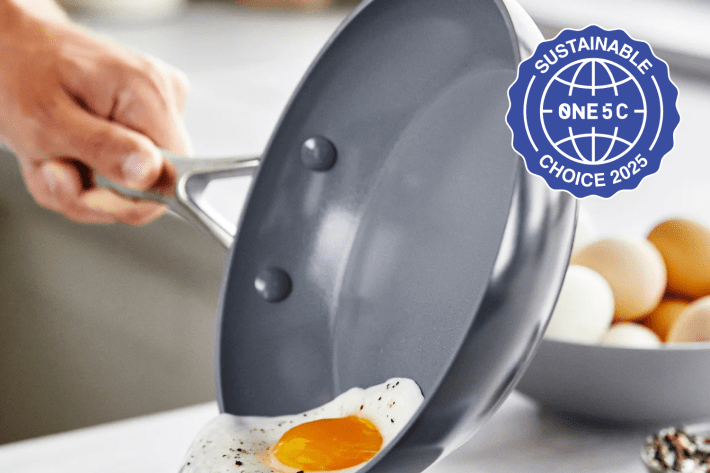
The GreenPan Valencia Pro Ceramic Nonstick Skillet ($70; greenpan.us) is a low-maintenance workhorse with a thoughtful design. It’s lightweight, yet sturdy, with an ergonomic handle that makes one-handed flipping a breeze. Even after months of consistent use, the ceramic coating retained its fresh-from-the-box appearance. It’s easy to clean, works with all cooktops (including induction), and is oven-safe to 600 degrees F. As a brand, GreenPan has an effective take-back program for old pans, uses recycled materials in their packaging, and fashions their cookware from 65% recycled aluminum.
Runner-up: OXO Ceramic Professional Nonstick Frypan
This skillet ($80; oxo.com) rivals GreenPan in terms of durability and performance with a few added design perks. It has a larger cooking area and rolled edges, both of which help food easily slide onto the plate. However, its durability comes with a cost: Its heavy-duty induction base adds some bulk, and the thick handle is a bit difficult to maneuver.
What nonstick ceramic pans we tested
We focused on skillets that come from well-known brands and have strong customer and professional reviews. All models we selected are free of PFAS and feature an aluminum base with a ceramic coating. To keep the playing field even, we tested the smaller size of each product line—between 8 and 9 inches in diameter and weighing 20 to 27 ounces. Prices ranged from $50 to $105, depending on the brand. Here are the skillets we tested:
- Calphalon Hard-Anodized Nonstick Frying Pan
- Caraway Mini Fry Pan
- GreenPan Valencia Pro Ceramic Nonstick Skillet
- Kyocera Ceramic Coated Nonstick Skillet
- OXO Ceramic Professional Nonstick Frypan
How we picked the best nonstick skillet

Our product recommendations are based on two parallel assessment tracks: one for performance and one for sustainability. These ratings combine to land on our final winner, which represents the ideal blend of a product that’s good for the Earth and for your life. Read more about our assessment process here.
How we tested nonstick skillets
We used each skillet for two months, cooking a variety of foods with no oil as well as minimal oil (many manufacturers recommend this for longevity of the coating) to see if the ceramic surfaces remained truly nonstick after repeated use and washing. In addition, we we conducted the following graded tests to evaluate performance under more-controlled conditions:
- Fried egg test: We fried one over-medium egg with ½ teaspoon of oil, shaking the pan before flipping to see how easily the egg released. We checked for sticking, flipping ease, and noted if the pan’s design allowed us to flip the egg with one hand.
- Scrambled egg test: We scrambled two eggs on medium-low heat with ½ teaspoon of oil, stirring constantly, and checking for any sticking. We also looked for any browning or discoloration, which would indicate excessive heat transfer.
- Pancake test: We cooked three pancakes in each skillet over medium heat with ½ teaspoon of oil. We checked for any uneven cooking or sticking.
- Scratch test: We ran the edge of a metal spatula across the bottom of each skillet 10 times and checked for visible scratches.
How we scored sustainability
Our sustainability ratings take into account three factors: a product’s environmental impact at its production, what happens at its end-of-life, and the manufacturer’s environmental behavior. Production factors in where, how, and with what a product is made—as well as how it’s transported through the supply chain. End-of-life takes into account the toxicity of the materials used, the product’s warranty, whether the company has a warranty or offers repairs, and how brands help buyers recycle old products. The final factor involves actions the company takes outside the life of a product to minimize its footprint or benefit the environment, and we award bonus points for transparency, as well. These scores are informed inferences based on available information, not full-blown life-cycle analyses.
How the GreenPan Valencia Pro performed
At the start of our testing, every skillet stayed true to its nonstick promises. By the halfway point—after several uses and washes—the top performers began to pull ahead. At the end, it was the overall pan design that determined our winner.
The GreenPan Valencia Pro ($70; greenpan.us) still looks exactly like it did when we opened the box. It was the only skillet that released fried eggs, omelets, and pancakes perfectly every time—with and without oil. It quickly became our favorite pan to work with, thanks to its lightweight body and comfortable handle that stayed cool during cooking. Other pans, like Caraway’s Mini Fry Pan ($105; carawayhome.com) were easy on the eyes, but felt bulky and had awkward handles that made one-handed flipping almost impossible.
The GreenPan resisted damage on multiple fronts. It held up against metal utensils and many dishwasher cycles. While all of the skillets are oven-proof to at least 450 degrees F, not all of them retained their slick, stain-free surfaces afterwards. The GreenPan and OXO Professional Ceramic Nonstick Frying Pan ($80; oxo.com), both rated to 600 degree F, survived repeated trips under the broiler without any damage or discoloration. It’s also helpful that the GreenPan’s entire interior is coated in ceramic, including the rivets, which tend to rust first. The Calphalon Ceramic Nonstick Frying Pan ($55; amazon.com) and Kyocera Ceramic Coated Nonstick Skillet ($55; kyocera.com) models both started rusting during tests.
Nothing’s perfect: We had zero gripes with the GreenPan, performance-wise. So, we wanted to offer a tip about these ceramic-coated pans. While they’re more sustainable than traditional nonstick, they’re not indestructible. Cast-iron, carbon-steel, and stainless pans can last a lifetime, but ceramic nonsticks eventually wear out. They can last five years or more with proper care, including handwashing, using only silicone or wood utensils, and avoiding spray oil—which most companies say explicitly not to use as they could potentially burn and permanently stain the pan.
Why the GreenPan Valencia Pro is sustainable
Sustainability efforts varied widely across cookware brands, but GreenPan earned top marks for its commitment to circularity. It’s the only company we looked at that offers a recycling program for old cookware. For a $20 shipping and handling fee, you can send in any kitchenware that fits in the skillet’s box, and GreenPan will recycle it. Additionally, the GreenPan Valencia deserves praise for longevity and durability, thanks to features like chip-resistant rims and a lifetime warranty.
On the manufacturing side, GreenPan owns its own factories in Italy and China, giving it more control over how those facilities operate and where their power comes from. The company says 47% of its factory energy comes from renewables (some from its own rooftop solar panels), and purchases carbon offsets for shipping (an imperfect solution, but better than nothing). It also reports 60% lower CO2 emissions during the nonstick curing phase compared to its competitors.
GreenPan uses recycled cardboard and plastic packaging, and the skillet itself is made with 65% recycled aluminum—excluding the handle. It’s also the first cookware company to earn Aluminum Stewardship Initiative’s Performance Standard for its responsible production and sourcing of the metal.
Nothing’s perfect: We would love to see GreenPan close the gap and reach 100% renewable energy use, and set a clear path toward net-zero emissions across its entire business and supply chain. The company needs to be more transparent, specifically by publishing information about its carbon emissions and water use, and backing up claims about being toxin-free and how it manages to emit less carbon during curing.
We’re not the only ones who'd like to see more: In 2019, a class-action lawsuit was brought against GreenPan for false advertising about its non-toxicity (aka greenwashing), though it was quickly dropped. Although the company changed some of its advertising language in response, it hasn’t done much to increase transparency around toxicity. To be fair, though, they're far from the only brand whose claims have come under scrutiny.
The runner up: OXO Ceramic Professional Nonstick Frypan
The OXO Professional Ceramic Nonstick Frying Pan ($80; oxo.com) was as durable as the GreenPan, still looking smooth after our metal spatula scratch test. It’s also dishwasher- and broiler-safe, and showed no signs of rust or discoloration after two months. In our cooking tests, eggs slid right off the pan and pancakes flipped effortlessly—though, unlike GreenPan, they did benefit from a little grease every time.
Design-wise, the OXO skillet is 4 ounces heavier than GreenPan’s with a bulkier handle that we found to be a bit less comfortable to hold. While it offers more surface area due to its rolled edges, the pan’s design caused some oil to pool near the sides. This was most noticeable when making scrambled eggs, which required more scraping and nudging on the edges of the pan to release the curds.
OXO placed third in our sustainability rankings, below GreenPan and Kyocera. Still, we appreciate that the company is a member of the Climate Action Corps, a group of brands committed to measuring and reducing emissions. Also helpful: Its parent company Helen of Troy releases a yearly sustainability report detailing data on its emissions and water use. However, we’d love to know where the company is in terms of transparency about how it sources materials and its plans to recycle what’s spent.
Gabriella Vigoreaux is a recipe developer and test-kitchen veteran whose work has appeared in Good Housekeeping, Epicurious, Saveur, and Cherry Bombe. She’s co-owner of Bandidas Bake Shop in Lakeland, Florida.
Tyler Santora is a freelance science journalist, editor, and fact-checker. He’s written for publications such as Undark, Scientific American, Popular Science, and more.
one5c does not earn a commission on any product purchased through our reviews.