
On any given summer evening, there’s a nonzero chance you’ll find me at a baseball game. Majors, minors, the unnecessarily competitive “Dad league” in the park: I eat it all up—usually along with a hot dog. I love baseball, but I really (really) love hot dogs.
Yes, I know how they’re made, and yes, I’ve seen the videos. Don’t care. There’s something about that snap. That perfect zigzag of yellow mustard (sorry, ketchup people, you’re wrong). That sharp tang of good kraut.
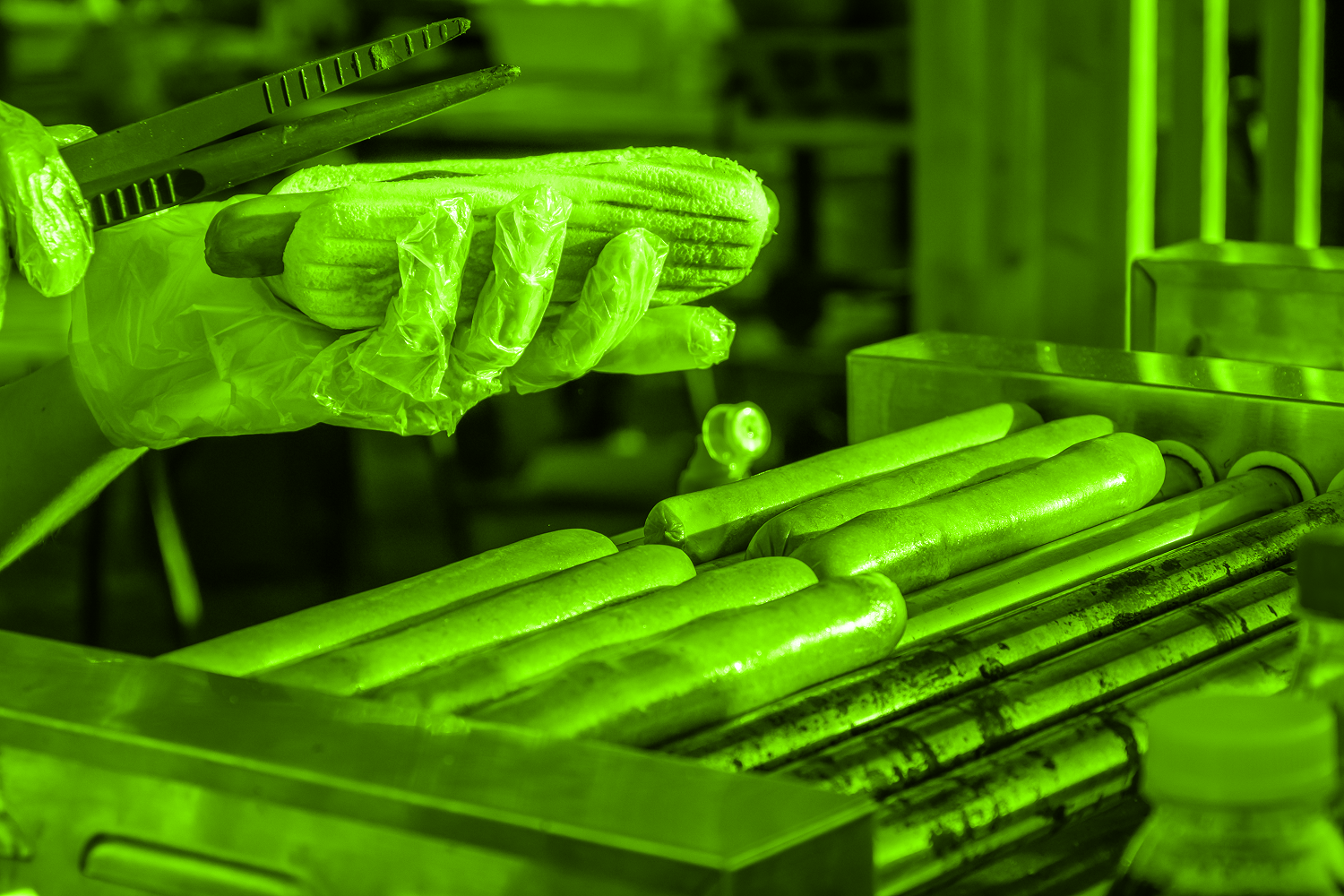
Ballparks aside, I’ve been holding on to a take hotter than the steamy water in a Times Square wiener cart: Hot dogs are a climate solution. Ground, bound, and bundled into perfect meat tubes, glizzies, as the kids call them, can be a gateway drug for plant-based skeptics. There’s a growing number of meatless frankfurters on the market, and I could cast any one as the poster child for how we can cut the emissions of the standard American diet, which is among the meat-hungriest in the world.
Yay, hot dogs! A climate win! Or at least they should be. Here’s the rub: What makes a hot dog a powerful conversion tool for Earth-friendly eating could also be its undoing. My darling dogs are an ultraprocessed food, which kinda stinks—and not just for the health reasons you’re undoubtedly already thinking about emailing me to point out. (Again: Yes, I’ve seen the videos.)
There’s plenty of evidence that faux meats can satisfy—even fool—the most devoted carnivores. Impossible’s mock chicken nuggets bested offerings made with real bird in a tasting at America’s Test Kitchen. In our own throwdowns, a cheeseless boxed mac from Kraft and a faux frank from Oscar Mayer crushed the competition in their respective categories.
We’ll start with the good part. Hot dogs are often made from, if we’re putting it more delicately than most of the internet, the “extra” bits of cows and piggies. We all know this and yet Americans still collectively spend around $8 billion on wieners every year. So why wouldn’t we just pivot from this accepted mystery meat to mystery plants?
There’s plenty of evidence that faux meats can satisfy—even fool—the most devoted carnivores. Impossible’s mock chicken nuggets bested offerings made with real bird in a tasting at America’s Test Kitchen. In our own throwdowns, a cheeseless boxed mac from Kraft and a faux frank from Oscar Mayer crushed the competition in their respective categories.
Know what those two winners have in common? Both came out of collaborations with a company called NotCo. It creates meat analogs by breaking down the molecular structures of the OG versions of popular foods and then matching those flavors and textures with plant-derived ingredients. Neat, right? Even neater: By their estimates, if they can claim just 20% of the animal-food market, that could axe up to 10% of food industry emissions.
NotCo uses an AI called Giuseppe to do this, and the energy demands of that kind of approach always give me pause. But it’s a totally different kind of processing that freaks me out. What could put me right off of my hot dogs is the fact that the fossil fuel industry appears to see ultraprocessed foods as an escape hatch to keep up their polluting ways.
The food industry is responsible for about 15% of the world’s fossil fuel consumption, which is as much as the E.U. and Russia combined. A chunk of that goes to making the petrochemicals in pesticides and fertilizers, but around 42% traces back to manufacturing and processing, which also includes lots of plastic packaging. In short: The dead dinosaur business is what enables ultraprocessed grub to be inexpensive and, therefore, pervasive.
I say this with a bit of hesitation, because this is a trap those of us who make a living sweating sustainability often find ourselves falling into. Convenience always seems to come with a catch. I also don’t love adding another voice to the chorus of people railing against ultraprocessed grub—because food deserts are real, and not everyone has the time or money to eat an entirely whole-food diet. But that says more about a broken system than individual choices.
And I’m wary of letting the delight of a hot dog get spoiled by a spiral into climate doom, an insidious flavor of denial that says if a solution isn’t perfect it’s not worth doing. Even accounting for its potentially oily beginnings, a plant-based dog still has around 1/6th of the emissions of a beef one. Besides, I wouldn’t recommend anyone eat a frank a day the same way I wouldn’t tell them to down a steady diet of Shake Shack. I suppose that balance is really the endgame if the point of making a good not-hot-dog is to get people past step one: opening their minds to meat alternatives.
As for me? We’ve got tickets to see the Mets at Citi Field soon. Last I checked they’ve got a veggie dog on the menu, and I’m not about to spoil my supper.