
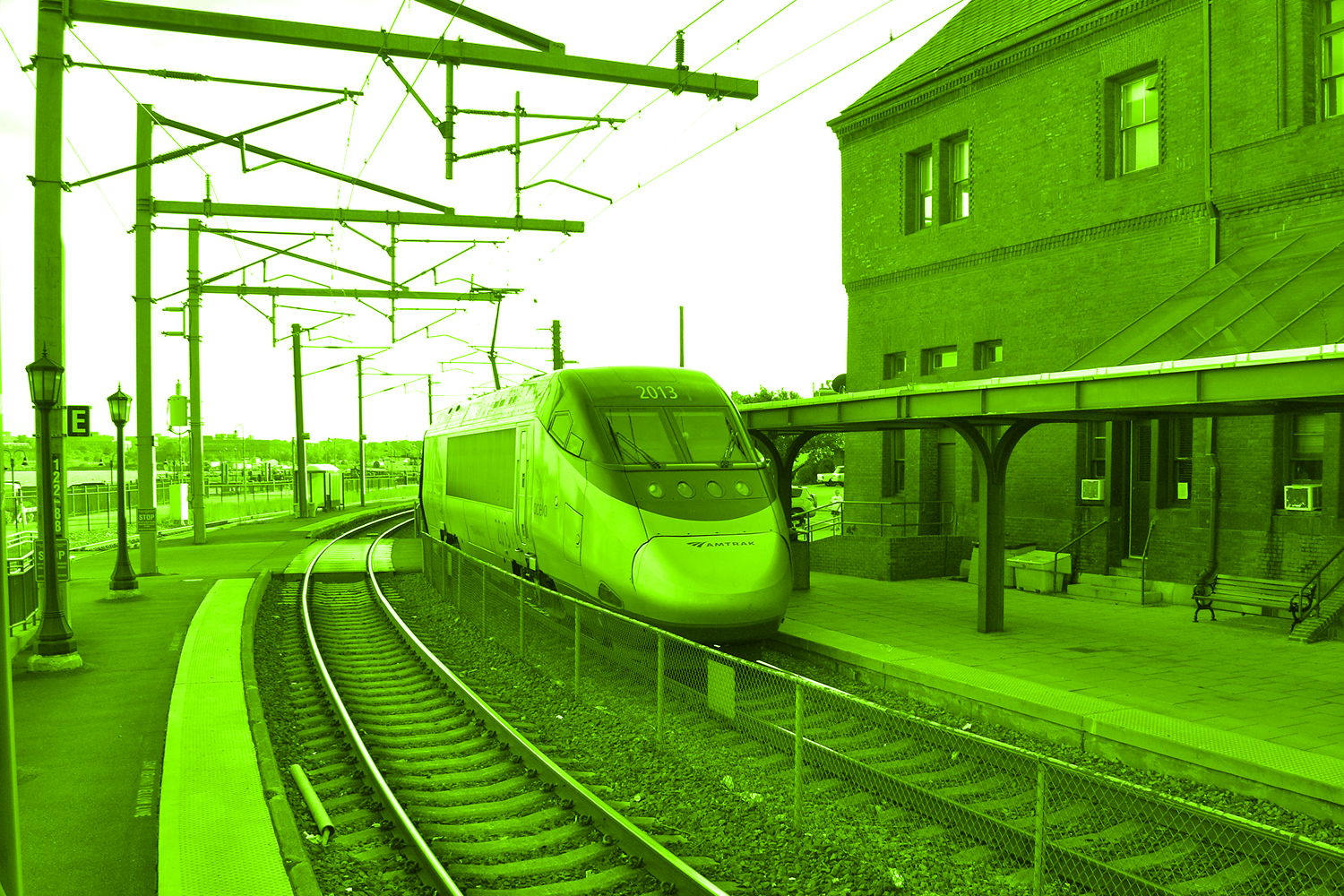
I’m writing this on the Connecticut Coast somewhere between New London and Mystic. It’s my favorite stretch of the Amtrak ride from New York to Boston, a spot where the train rocks gently as it skirts the shoreline.
This rail journey is the most pleasant and also the most climate-conscious way to transit between those two cities. My ticket will run me 25.3 kilos of carbon dioxide equivalent gases. Driving the same stretch would be 135. And flying around 141.1.
That math is a big outlier in the U.S., given the state of our rail infrastructure, which is something I think about often this time of year. This is one of the seasons lots of y’all email us the same question: What’s the most environmentally responsible way to travel from Point A to Point B?
I wish I could give a simple answer. I want it to be a layup, because I love trains—have since I was a kid. But I’ve come to dread the question, because the answer is not to take the train…but also that you should. Confused? Me, too. All aboard, friends, we’re about to take a ride on the mental merry-go-round I've dubbed The Amtrak Trap.
If you want to cut your emissions, staying out of cars and planes is a great place to start, and public transit, especially trains, is a big piece of making that possible. But if you’re trying to find the lowest-emitting means of long-distance travel within the U.S., in most instances the plane edges out the train. Of course there are no hard-and-fast rules, because there are numerous variables in each trip. But if we’re talking about flying from, say, the Midwest to Disney World or cross-country, a coach seat on an airplane wins out from a purely carbon perspective. A Department of Transportation analysis put the tipping point at about 700 miles.
Climate-minded people tend to view the train as a salve for what the Swedish have dubbed “flygskam,” or “flight shame,” but it’s not universally the right choice. The Northeast Corridor, which runs between Washington, D.C., and Boston, is the brightest green spot on the Amtrak map.
Climate-minded people tend to view the train as a salve for what the Swedish have dubbed “flygskam,” or “flight shame,” but it’s not universally the right choice. The Northeast Corridor, which runs between Washington, D.C., and Boston, is the brightest green spot on the Amtrak map. That’s because these 457 miles of track are among the only ones equipped to run electric trains. Pretty much everywhere else the choo-choos go chug-chug by burning diesel. Passenger emissions per mile traveled from the seat I’m in right now are 0.13 kilos; elsewhere it’s 0.28.
There are also practical things that can stink about the train. Amtrak shares routes with freight trains, which can slow things down a lot. And the network is limited: The U.S. has around 500 stations, compared with around 5,000 public airports. Yet Americans are clear that they want more and better trains; one 2023 survey found that 83% of folks want Congress to invest in passenger rail.
I explained this to my father as he played solitaire on his iPad in the seat next to me. He looked up with a raised eyebrow: “So then how do we fix it? How do we help make it better?”
I could give him a long diatribe about the complexities of building and modernizing rail infrastructure—about the costs, the timelines, the lack of political will. But I don’t. I give him the best answer I’ve got: If we want more and better trains, we have to keep riding the trains we have, and let go of the guilt that a 1,000-mile rail journey might be a little worse for the planet than flying.
I tell him to look at the bigger picture. The average passenger rides far less than 700 miles. And even if you are among those taking a route end-to-end, and therefore shouldering more individual emissions, you gotta remember that a train can do what a plane cannot: replace thousands of shorter car journeys. A single line can service hundreds of different combinations of origins and destinations; a plane only has Point A and Point B.
Does knowing all that magically turn diesel fumes into something as benign as the mist coming off the water to my right? No, but at least it gives us a little hope about where we’re headed.