
This sweltering summer, you may have found a new best friend in your air conditioner. But your energy bill probably feels differently. In the U.S., AC alone accounts for about 19% of total energy consumption in homes, and the average energy bill will likely jump by 8% as temperatures climb between now and September.
But blasting cool air from a conventional condenser is also one of the biggest contributors to greenhouse gas emissions. About 4% of global emissions trace back to air conditioning, nearly twice as much as those generated by the airline industry. And as human-caused climate change spurs more frequent and intense heat waves, demand for indoor chillers could triple globally by 2050.
Even when the temperature outside makes shutting off AC a hard “no,” it is possible to dial down the thermostat a few notches. Doing so comes down to harnessing the physics of airflow and heat transfer and leaning into tactics that leverage your body’s natural cooling system.
Block the sun
The U.S. Department of Energy estimates that about 76% of the sunlight that hits your windows becomes heat. Keeping your panes closed and covered during the day, especially when the sun is at its hottest, can reduce your need for a cooling aid.
Blackout treatments or blinds will work best, but there are also options if you don’t want to live in darkness. Peel-and-stick solar film, for instance, can block up to 78% of the sun’s warmth from entering a dwelling; in one case study, homeowners saw a temperature drop of 10 to 20 degrees Fahrenheit. Cellular shades, which have accordion-like folds that form an internal honeycomb pattern that acts as an insulator, can cut unwanted solar heat by up to 60%. Other coverings, like slat-style louvered blinds or rolling roman shades, can also help, though they’re less effective. Opt for lighter colors, which are more reflective, and heavier materials whenever possible.
Make a cross-breeze
Keeping air moving doesn’t necessarily lower temperatures, but it does create a chilling sensation as it helps sweat evaporate off the skin—your body’s natural cooling mechanism. If it’s decent enough out to have the windows open, cross-ventilation can let you feel the breeze while also pulling cooler air inside and pushing warmer air out.
To create a breeze, open at least two doors and/or windows on opposite sides of your home, providing an inlet and an outlet. For this to work best, you’ll also want to take advantage of convection—the natural tendency for hot air to rise—by placing the inlet at a lower level than the outlet. This can be as simple as lowering the top sash of a window instead of the bottom. You can also help this along by placing table or floor fans on opposite sides of the house to initiate some moving air. Good cross-ventilation can have a cooling effect of around 11 degrees Fahrenheit at the hottest point in the day.
Optimize your ceiling fans
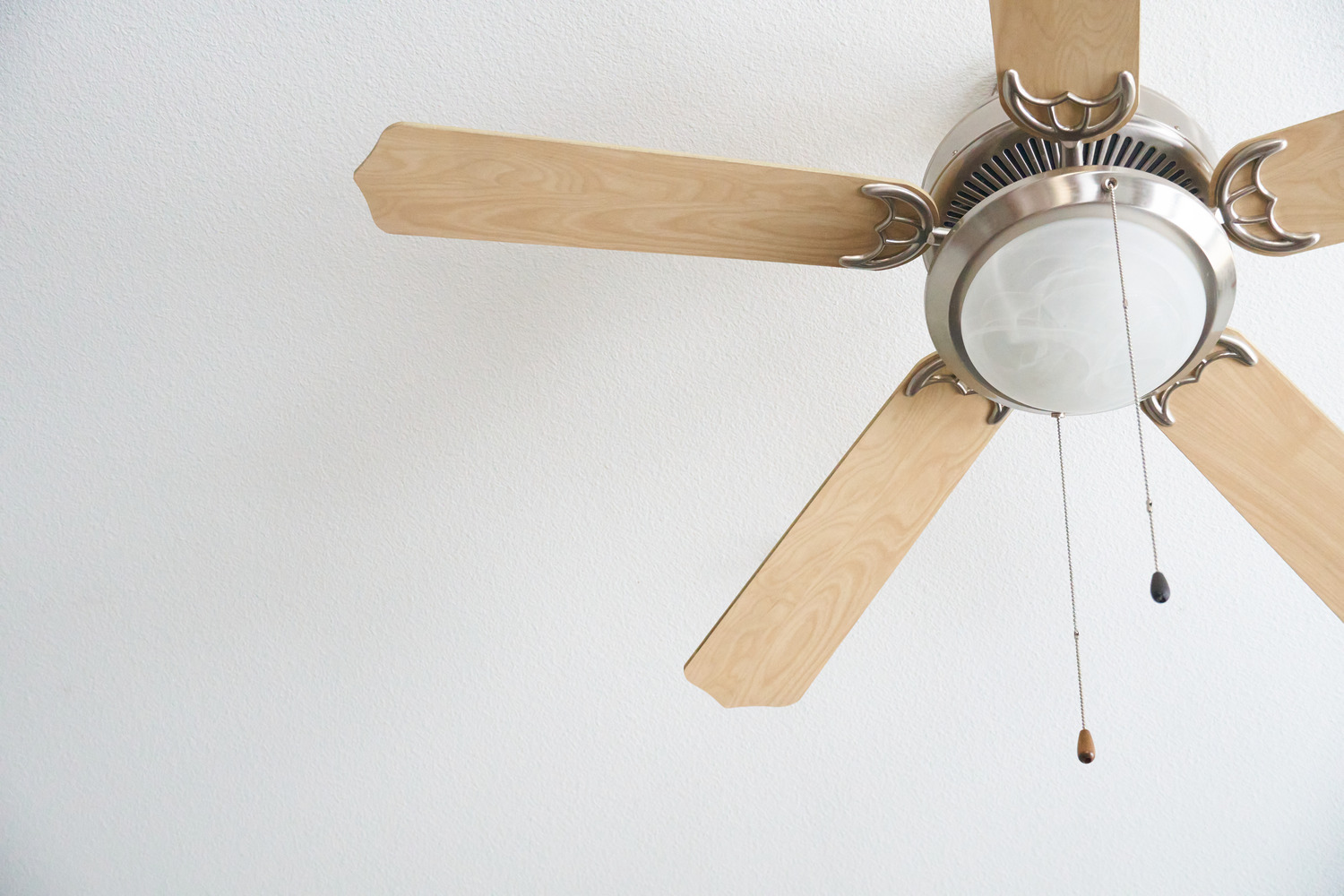
Like cross-breezes, a gentle wind coming off a ceiling fan can help sweat evaporate from your body quicker than still air. While the degree of cooling depends on how fast the air is moving and how humid it is, a fan can let you adjust the thermostat up by 4 degrees Fahrenheit. Most fans are bidirectional, so glance up at yours and make sure it’s spinning counterclockwise, which creates a downdraft. If it’s going the wrong way, turn it off and find the switch that allows you to flip the spin.
A wobbly or dirty fan is also an inefficient one. Dusty blades may not slice through the air as well as clean ones—and they’ll also fling crud around the room. Add wiping down the blades to your cleaning routine, and while you’re up there check to make sure to check and tighten up any fasteners. This guide from Home Depot walks you through what you’ll need to do.
Keep humidity in check
Humidity is a measure of evaporated moisture in the air. On days that are hot and humid, the air is simply too saturated for sweat to evaporate efficiently, making you feel even hotter. When it’s damp out, a dehumidifier can be your hero. Dehumidifiers work by condensing and collecting water vapor, and then releasing drier air back into the room. According to the EPA, the ideal for indoor humidity is 30% and 50%. Lower humidity will not change the temperature of your home, but can lower the real feel to make it seem cooler.
Pick your appliance moments
Appliances like ovens, dishwashers, and refrigerators generate a lot of heat as they do their jobs. In some cases they are responsible for more than 16% of the heat in a home. While you can’t do much about your refrigerator, make sure to use things like ovens, dishwashers, and clothes dryers during cooler hours—if you use them at all.
You can, for example, line-dry your clothes and opt to grill or tap another alternative cooking method. Baking a pie in the oven, for instance, could raise the temperature in your home by 1 to 10 degrees Fahrenheit, while using a smaller appliance like a toaster oven or air fryer will do less to kill your chill.