
Something is nagging me about my compost. There’s nothing nasty going on. It’s not stinky, funky, or buggy. It’s just that my feelings about our household’s food scraps seem to contain multitudes. Part of me is grateful that I can send waste someplace other than the landfill, where it’d spurt the potent greenhouse gas methane as it withers. Part of me hates that there’s an easy out when I let my leftovers languish.
Part of me thinks that the word “compost” is what’s really chafing me.
By definition, compost is the nutrient-dense, soil-like stuff you get after microbes go to work breaking down organic matter like leaves and food waste. My bucket? It’s got the usual scraps (lemon hulls, eggshells, coffee grounds, zucchini butts), but there’s also a whole lot of other stuff in there too (spoiled cheese, a stale half-cupcake, the few bites of tuna salad I forgot in the fridge last week). If you’re a home composter, you’ll immediately see what’s strange here. Normally, putting all that into the pile is a no-no. The cupcake could squeak through—as could other baked goods, if you’re being lenient—but meat and dairy are usually off limits.
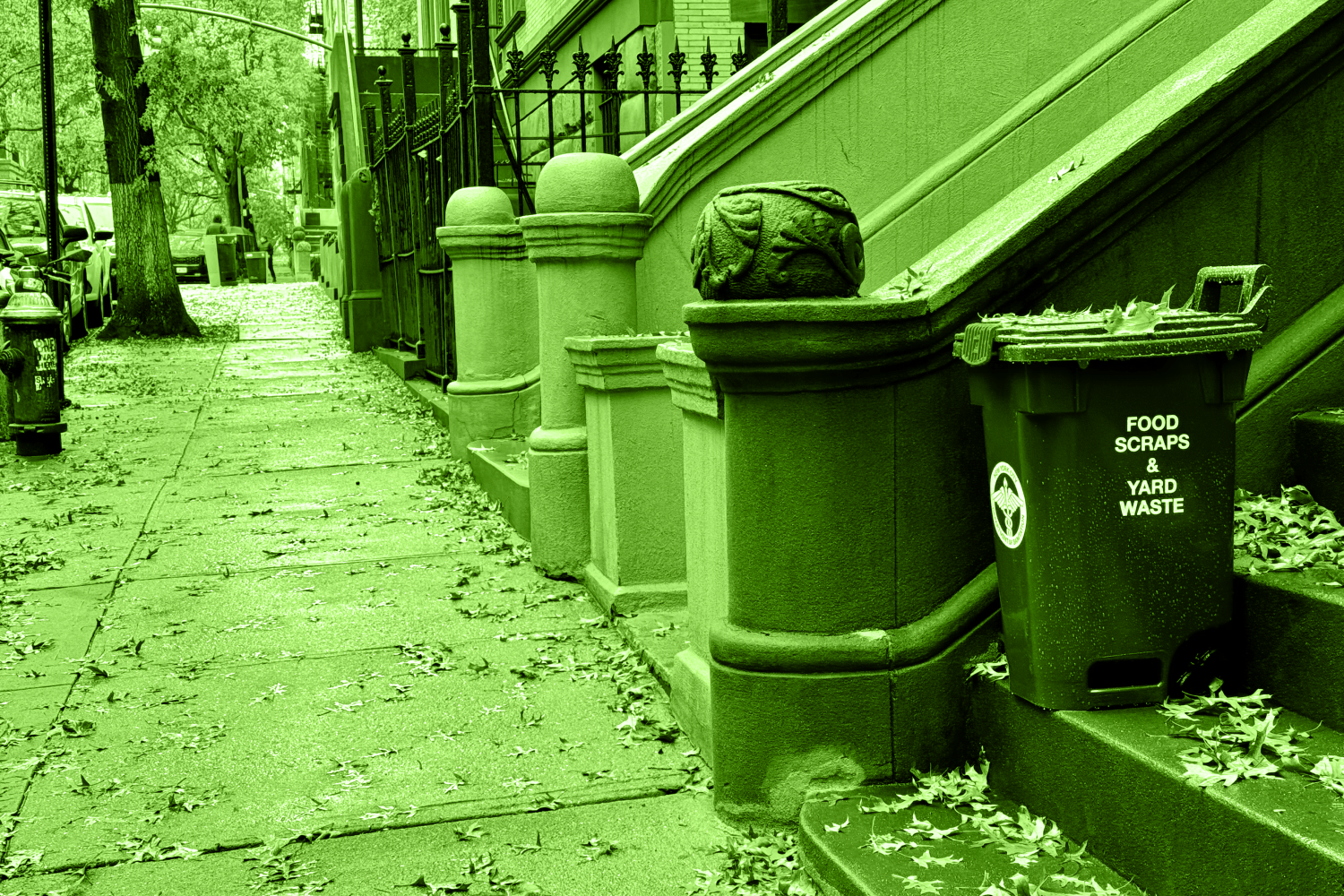
How is it OK for me to toss them in there? My compost isn’t headed to a backyard heap, but to an industrial facility that can safely handle those castoffs. I live in New York City, where the nation’s largest mandatory “composting” program rolled out this past spring.
Why the sarcastic quotes around composting? Well, our waste isn’t becoming the black gold that helps gardens and treebeds thrive. In fact, if you look at the city’s signage around the program, the word is conspicuously absent. Instead, they call it “organics collection.”
The vast majority of what The Big Apple collects is destined to become biogas—a methane-rich gas that can be burned for energy—not fertilizer. This setup isn’t unique to New York: L.A., for instance, has a pretty robust program that sends about 60% to compost and the remainder to biogas digesters. But it provides an easy window into the pitfalls of how we view and handle excess food in our cities and in our own homes.
The five boroughs generate roughly eight million pounds of food waste every single day. That’s 2,920 million pounds a year. If it winds up in the landfill, that amount of tonnage creates around 6.76 million metric tons of carbon dioxide equivalent emissions over its entire lifecycle, according to a calculator from ReFED, a nonprofit focused on eliminating food waste. That’s as much planet-warming emissions as 1.61 million gas-powered cars create in a year.
The lowest-emitting use of food is (drumroll, please) food.
Turning that same amount of waste into biogas trims the total potential emissions by about 11%. That’s only a shade better than straight-up incineration, which would cut the greenhouse-gas output by 9%. You see where this is going: In the hierarchy of ways to divert food waste, digestion ranks pretty low on the totem pole, whether you go by recommendations from ReFED, the Natural Resources Defense Council, or the EPA. Biogas is a lot of things—potentially greenwashy, technically renewable, still definitely methane—but one thing it’s not is “compost.” I’ll give you that it’s not fracking-level bad, but that doesn’t make it benign.
Making actual compost out of New York’s food waste would cut associated emissions by 14% compared to it going to the dump, according to ReFED’s calculator. Surprised it doesn’t make a bigger difference? The easiest way to explain why is to look at what happens to emissions when just a portion of excess food gets donated and eaten rather than chucked. Let’s say one-quarter of the grub NYC tosses is neither “compost” nor “organic waste” but edible food that could go to kitchens or other means of rescue, and the other three-quarters still went to the digester to become biogas. Plug that split into the same calculator, and the emissions cut jumps to 27% compared to sending it all straight to the landfill.
This is the upshot for anyone, anywhere, not just those of us lugging scraps to curbside bins: The lowest-emitting use of food is (drumroll, please) food. That means casting any vittles that we’re not going to eat as “compost” is a slippery slope. I worry that programs like the one in NYC risk masking that by giving us an out for chucking good grub that’s just a little too easy. The average U.S. household bins about one-third of the food it brings home, and we’re among the food-wasting-est nations on Earth on a per-person basis.
All this was spinning around in my head this morning, as I scraped the last pieces of a forgotten California roll into our organic-waste bucket. Is this all just a license to waste? I asked myself. Then I remembered that everything is a work in progress. If NYC’s program was pushing me—a person who was already aware of the climate impact of food waste—into hyperawareness, it must also be instructive to New Yorkers who may be having that thought for the first time.
Forcing more people to separate out the half-sandwiches, pints of leftover rice, or slices of pizza (for shame!) they chuck, can nudge us to rethink not only what we put in the bin but also how much food we're bringing home that might never get eaten. Much of our excess is not “compost” or “organic waste” or even “food waste.” Sometimes it’s food—plain and simple. And 8.5 million people coming face-to-face with how much perfectly good grub they might be tossing sure seems like progress.