
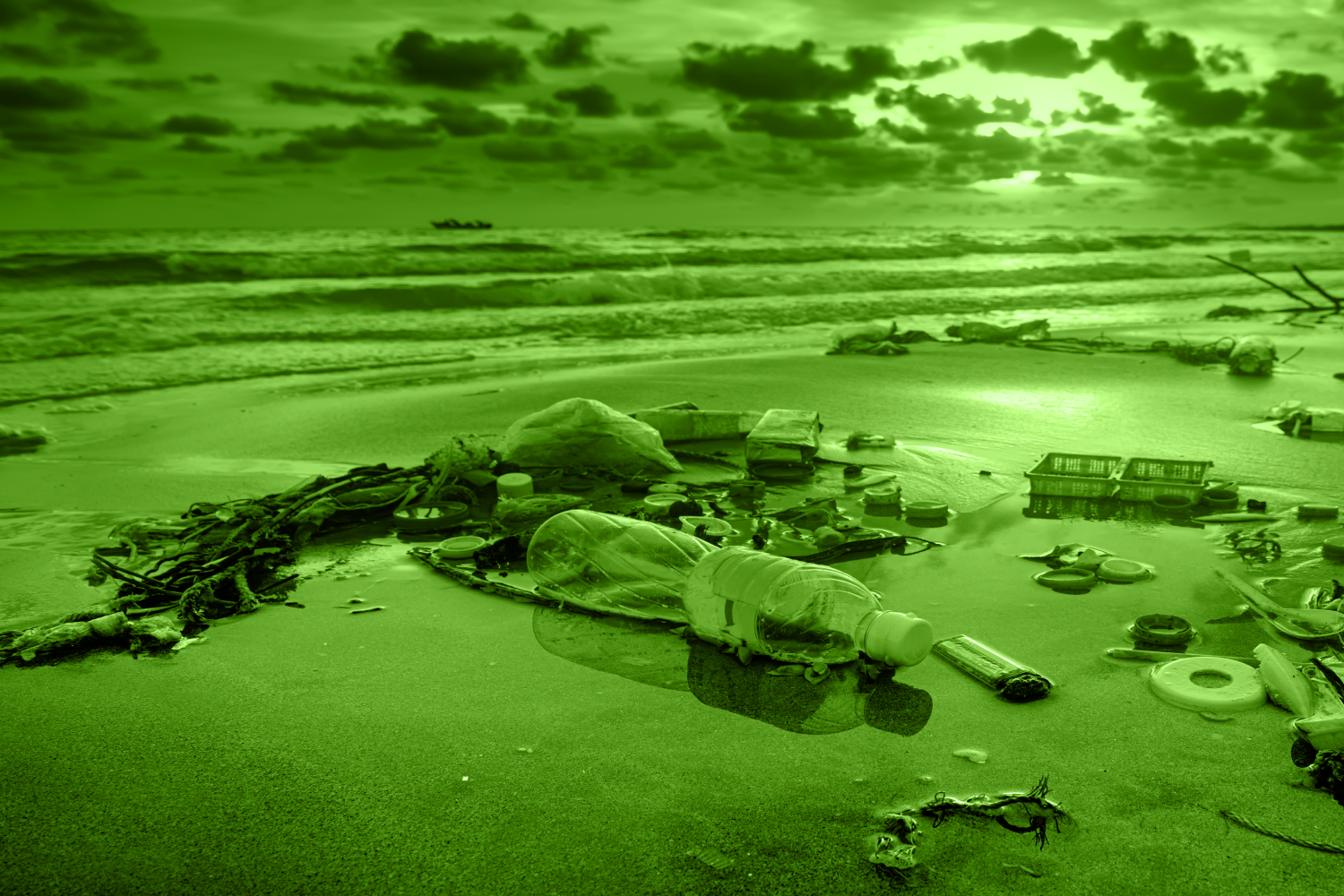
What negotiators hope will be the final round of talks to ink a global treaty to address plastic pollution ends tomorrow. Delegates from more than 170 countries have been meeting in Geneva since this time last week, after the last round of talks ended in a deadlock. The sticking point: Whether or not to institute a cap on plastic production. Nations that produce fossil fuels and petrochemicals argue that managing waste, not making less stuff, is the answer.
As the world becomes increasingly overwhelmed with plastic—we produce about 460 million metric tons a year, a pace that’s expected to triple by 2060—people like Richard Thompson are in Geneva urging negotiators to follow the science and adopt an ambitious treaty to safeguard future generations from the widespread impacts of unchecked production. Thompson is a marine biologist focused on litter at the University of Plymouth and co-coordinator of the Scientists' Coalition for an Effective Plastics Treaty, a group of more than 450 independent researchers focused on feeding policymakers evidence-based information on solutions that can stem the tide. He also coined the term “microplastics” in a landmark 2004 paper. (NBD.)
We caught up with Thompson to get a read on how negotiations are progressing, what scientists want to see in a final agreement, and what he thinks a less plastic-y future could look like.
Corinne Iozzio: Your 2004 paper was the first to use the term ‘microplastics.’ Did you have a sense when you published it of the scope and gravity of what you were looking at?
Richard Thompson: People had counted small plastic before. They've counted them since. It's a team effort. There's now over 4,000 papers on the topic of microplastics. It's gained traction because of all of that, and because the quantity of plastic pollution has doubled since that paper. Plastic pollution now contaminates our planet from the poles to the equator, from our deepest ocean to our highest mountains—literally near the summit of Mount Everest. There's adverse effects of plastic demonstrated on hundreds of different species. There are clear economic impacts, and there's clear evidence of harm to human health and wellbeing. The quantity of plastic produced, which is directly proportional to the quantity of plastic pollution, has increased 200 times over. So it's clear that we need to take action on it.
CI: What’s at stake in Geneva?
RT: In a way, I would say that the U.N. resolution that's brought us all here to Geneva is a pretty clear signal that our current practices of design, use, and disposal of plastics are not sustainable. What we need is the negotiators to look beyond the short-term horizon of politics, to look to the next generations. Some of the Indigenous people working here, it's part of their culture: If they make any change that could have an environmental impact to look ahead five generations. It's that kind of approach that we need. And regrettably, there are some here with very low ambition that are driven by short termism and short-term profits. And that's what's at stake.
CI: What does looking forward in that way entail? What’s the difference between a ‘low’ and ‘high’ ambition approach?
RT: I can describe what the science is telling you, because I’m not a policymaker. This isn't a treaty to end plastic production. It's a treaty to end plastic pollution. We need to make sure that the plastics we make going forward are safer and more sustainable than they are today. We often think plastics are cheap. Well, they're not cheap in terms of their external impacts. A paper came out last week demonstrating $1.5 trillion in health costs per annum associated with just a few chemicals used in plastics. So there are immense external costs.
"Of course governments and industry have been saying ‘well, we can recycle, reduce, reuse.’ It's a phrase that came in decades ago. I mean, it's really clear that we can't recycle our way out of here, but it is part of the picture, right?"
Richard thompson, Scientists' Coalition for an Effective Plastics Treaty
Because of those costs, we need to introduce criteria around essentiality—we need to make sure that the plastics we're using bring an essential societal benefit. Simply because there's a market for something that doesn’t mean it's essential. You could take the microbeads in cosmetics, which are now banned. I've heard nobody complain that they can no longer scrub themselves in millions of small bits of plastic every morning. They were clearly non-essential. There's of course a limit to how many things you can ban and prohibit, but there are certainly some things we don't need.
CI: When we think about plastics, the term ‘sustainable’ feels a bit like a contradiction. What does that look like?
RT: I would point to the chemicals that are used in plastic: There are 16,000 chemicals associated with plastic production, of which some 4,000 are known to be harmful, but very few are regulated. And so it's going to be essential that we have chemicals in the scope of the treaty if we hope to ever produce plastics that are safer than they are today.
Then to sustainability, that's thinking about if we can move towards longer-lasting formats, reuse formats. We can design, perhaps for circularity, but also coupled to that is this essential use concept where we're not producing things that we don't need. That's a clear part of sustainability. And circularity is really challenging. At the minute, less than 10% of all the plastic we're producing each year is recycled, and less than 1% of that is ever recycled twice. That's an abysmal level. And of course governments and industry have been saying ‘well, we can recycle, reduce, reuse.’ It's a phrase that came in decades ago. I mean, it's really clear that we can't recycle our way out of here, but it is part of the picture, right?
CI: What stands in the way of plastics being more readily recyclable?
RT: The 16,000 chemicals that I reference. There are dozens of chemicals, in many cases, just to do the same job, like make your spectacles bendy. Why do we need dozens of chemicals to do that? We need it because Company A developed the first one and put a patent on it that would cost Company B a lot. And so now we've got this proliferation of everybody needs their own plasticizer. So we're going to need measures to reduce the complexity, to simplify the diversity of plastics, because, at the minute, it's a very hard challenge for a recycler to work with such a mixed materials of different provenance. Coupled to that, we'll also need to have standards on transparency, testing, and labeling. So basically that you can recognize a safe and sustainable plastic when you see one.
CI: The key tension at the talks has been the idea of capping plastic production. As far as the science goes, does a treaty work without that?
RT: The mandate that's brought us all here is a clear demonstration that business as usual is a business risk. We need to reduce production. It’s really clear that at the minute the levels of production are escalating away. They're diverging away from any ability that we've got to manage that waste. You know this certainly isn't a waste treaty. We have to address the whole lifecycle of plastics, and that is going to involve making less plastics. So I wouldn't want a cap that reduced plastic production by X—whatever that is—but for all of those plastics that we carried on producing to be just as unsafe and unsustainable as they are at the minute, that doesn't make any sense to me. So to me, the science-based approach is to develop those criteria around essentiality, safety, and sustainability.
CI: The average person interacts most with plastics—specifically the single-use variety—at the grocery store. If we follow the science, how does that experience change in the future?
RT: If I ask the product designers, they tell me they were never asked to consider end of life. When they designed those single-use products, they were asked to design something that functioned and that was attractive to the consumer. So it's hardly surprising that we've got a problem. That’s a really clear exemplification of why we cannot rely on industry to put in place its own checks and balances. I can remember being at a government meeting in the UK with some of the producers when the eight most problematic items of plastic packaging were announced, and the industry was up in arms. And I said to them, ‘Look, did any of you come in here this morning unaware that those eight items were problematic?’ No, of course they knew, and so heads have been in the sand.
"There are uncertainties beyond what you put in the recycling bin, but if you're giving the local authority what it's asking for and doing that to the best of your ability, there's not a lot more you can do."
Richard thompson, Scientists' Coalition for an Effective Plastics Treaty
So what we need is the supermarkets and the large brands to have stood up and done the homework that they should have been doing for decades to make sure that the packaging is safe and sustainable. So then the customer can go into the supermarket and buy with confidence and not have to agonize about whether or not they can recycle the packaging. I’d rather the consumer was concerned about the air miles on the strawberries that they were buying out of season than about whether or not the packaging they're buying is locally recyclable. That's where industry needs to step in.
CI: So, yes, this isn’t the individual’s problem to solve, but what can they do in the meantime?
RT: Sure, there's things you can do. You know, reusable, refillable coffee cups. Take a refillable grocery bag. Reuse those things if you have to buy plastic packaging—which, of course, we all do because we're not given any choice. Then try and buy it in a format that is locally recyclable. There are uncertainties beyond what you put in the recycling bin, but if you're giving the local authority what it's asking for and doing that to the best of your ability, there's not a lot more you can do. We need industry and policy to get the dots aligned.
CI: Given where we’re at right now—in terms of the pace of plastic production, but also the deadlock over capping it—do you still have hope?
RT: Absolutely. Because this isn't about not using plastic. It's about just starting to use it in a safer and far more sustainable way than we have. And it's clear evidence that there are ways of doing that and delivering it. You know, the question is really whether the negotiators feel confident to step up to doing that. There will be risks for some countries, and that's why financing will be really important to make sure we've got a just and fair transition. I remember speaking to one delegate in a previous meeting from a poorer country, and he said, ‘My heart is absolutely telling me I understand what the scientists are saying, why I need to act. My head is telling me my country might not be able to afford it.’
I don't believe his concerns were actually real. I think some of them were fueled by myths and corridor chats, possibly from those with lower ambition. So not every actor here is working in good faith and delivering most robust, accurate, independent information. And that's what we need a science body that's got a clear policy to ensure independence, because it's clear we can't rely on the industry to be their own gatekeepers.
We’ve edited this interview for clarity and brevity.